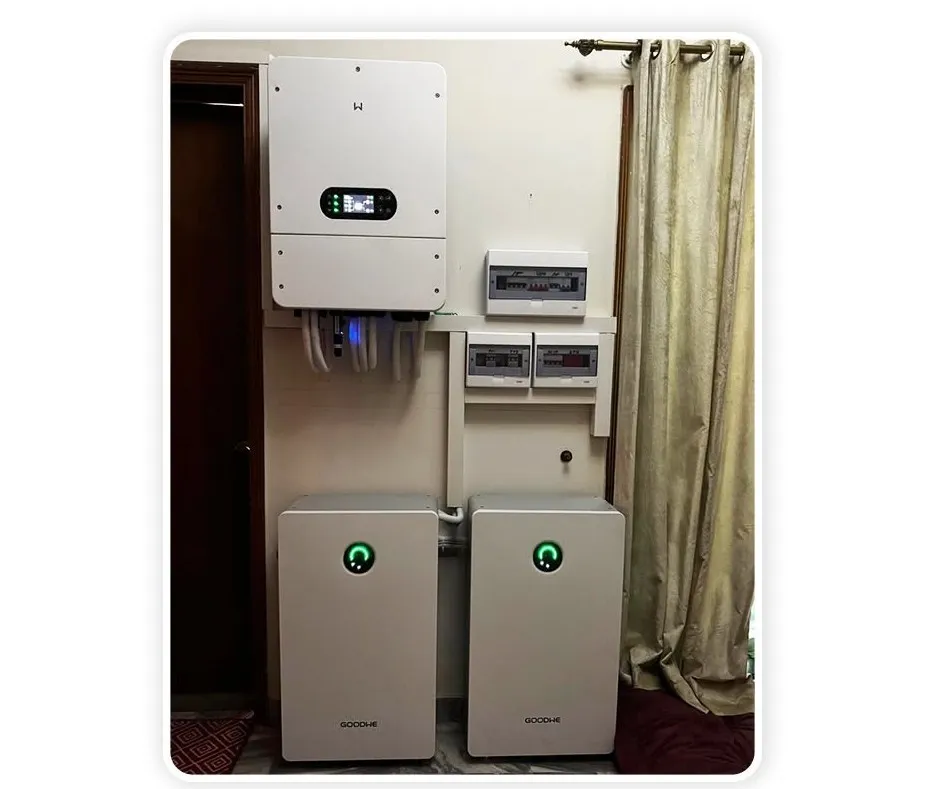
Bigger is not automatically better in backup power, but when a home has the load and the roof for it, a system this size changes what is possible: it can carry heavy appliances through long outages and push a large surplus back into the day's solar. Here is exactly what went in, and what the storage buys.
The system at a glance
| Part | What we used |
|---|---|
| Inverter | 15 kW GoodWe hybrid |
| Panels | JA Solar 710 W TopCon N-type bifacial |
| Battery | 2 × 14.3 kWh GoodWe LiFePO4 (28.6 kWh total) |
| Mounting | Roof-top tilted array on weighted footings |
| Location | Cavalry Ground, Lahore |
The panels: 710 W TopCon bifacial
The JA Solar panels here are worth naming because they are a generation ahead of the cheap modules that fill most quotes. Two things matter.
TopCon N-type cells run at higher efficiency than the older PERC panels, hold their output better as they heat up, and suffer far less of the first-year degradation that quietly shaves output off budget modules. In a hot climate, the better temperature behaviour alone is worth paying for.
Bifacial means the panel also generates from light hitting its rear, reflected up off the roof surface. On a bright roof and a mounting that leaves an air gap behind the glass, that back-side gain is real, typically a few extra percent across the year, on top of the cooler running a gap provides.
What 28.6 kWh of lithium really gives you
This is where a fully specified system earns its write-up. Two 14.3 kWh GoodWe LiFePO4 packs give 28.6 kWh of nameplate storage. Using the same method as our battery backup time calculator, and the site's standard figures (about 90% usable depth of discharge for lithium, and roughly 90% inverter efficiency), the energy you can actually deliver to the house is:
Turned into hours, that depends entirely on what the home runs during the outage:
- At a steady 2 kW (lights, fans, fridge, TV, and a bit more), that is roughly 12 hours of backup.
- At a heavier 4 kW (add an air conditioner or two), it is around 5.8 hours.
Those are estimates, not a logged result, and real backup shrinks a little in cold weather and as the pack ages. But they show the point of a bank this size: it is built to run a real household load right through the longest outages, and to soak up a big solar surplus by day. Plug your own load into the calculator to see your own number.
The inverter and the board
The 15 kW GoodWe hybrid is the white unit at the top of the photo, with its colour power-flow display. Below and beside it sit the distribution and protection gear, and the two GoodWe battery packs stand on the floor with their status rings lit green. Keeping the inverter, boards, and batteries grouped on one wall keeps the DC runs between inverter and battery short, which matters at this power level: shorter runs mean less voltage drop and less heat in the cable. For the reasoning on DC cable sizing, protection, and why a proper changeover is non-negotiable, see the safety section of our inverter sizing guide.
What we would add to these notes
To finish these notes as we log the data, we will add:
- The panel count and the total array size in kW, and the day's peak generation.
- A measured backup time under the home's real evening load, to sit next to the estimate above.
- A month of generation and self-consumption figures.
