A battery’s label rating is not the energy you get to use. Two rules, depth of discharge and the losses of real-world drain, cut the usable figure well below the number on the box. Understanding those, then choosing a chemistry and a system voltage to match your load, is the whole game.
Usable capacity is the number that matters
You cannot drain a battery to empty without damaging it. Flooded and tubular lead-acid banks are capped at roughly 50 percent depth of discharge; lithium (LiFePO4) safely reaches 80 to 90 percent. So a nominally identical 150 Ah battery gives you about 75 Ah of usable capacity in tubular but around 135 Ah in lithium. When you size a bank, work from usable capacity, never the label. The battery backup time calculator builds this in for you.
Chemistry: tubular, AGM, and lithium
Tubular lead-acid is cheap, forgiving, and heavy, but you use only half of it and it lasts three to five years. AGM and gel are sealed and maintenance-free with similar usable depth. Lithium costs more up front, but you use most of it, it lasts eight to fifteen years, and it barely cares how fast you drain it. Spread over its life, lithium is often the cheaper choice per usable kWh.
System voltage keeps the current sane
The same power moves with far less current at a higher voltage, and current is what forces thick, costly cable and wastes energy as heat. Small systems run at 12V, mid-size at 24V, and anything 3 kVA and up should use 48V. Because cable loss rises with the square of current, moving from 12V to 48V cuts that loss to a fraction.
Guides in this section
How to make your inverter battery last longer
Simple habits that add years to a battery, and the ones that quietly kill it.
5 min read · Updated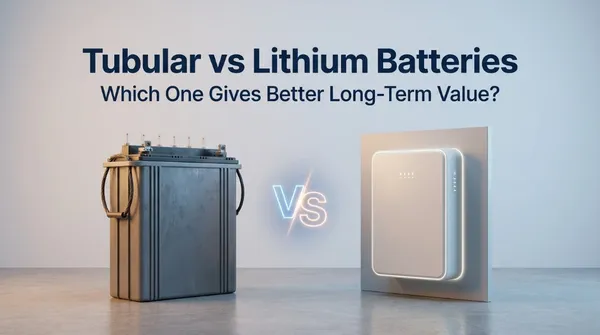
Tubular vs lithium batteries: which is worth it?
Usable capacity, lifespan, and true cost, and which battery is cheaper over its life.
6 min read · Updated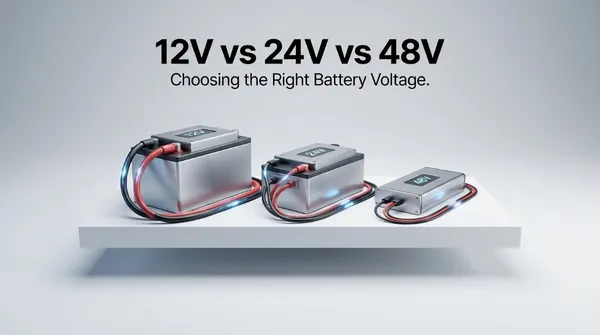
12V vs 24V vs 48V: which system voltage?
Why higher voltage means less current, thinner cables, and lower losses, and which to pick.
6 min read · Updated