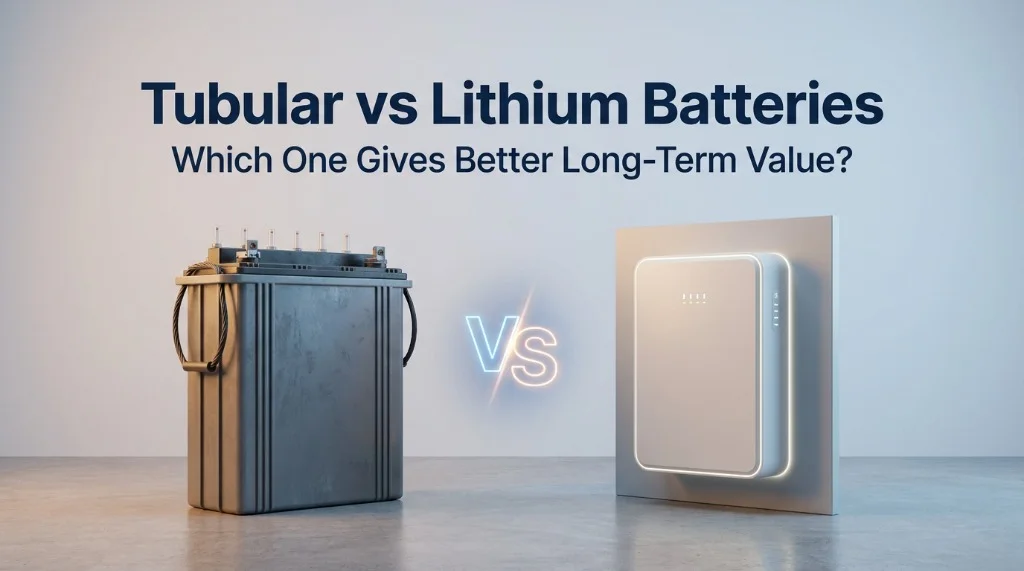
How they actually differ
Tubular is a type of lead-acid battery, the traditional choice for home inverters. It is heavy, cheap, and forgiving, and it stores energy in thick lead plates sitting in acid. Lithium here means LiFePO4 (lithium iron phosphate), a newer chemistry that packs more usable energy into far less weight and lasts much longer.
On paper they can carry the same amp-hour rating. In practice they behave so differently that the Ah number alone tells you very little. What matters is how much of that capacity you can use, how many times you can use it, and how the battery holds up under a real load.
Usable capacity: the real gap
You cannot safely drain any battery to zero. The share you can use is called depth of discharge. This is where the two chemistries split apart.
That gap changes everything downstream. To match the runtime of one lithium battery, you often need roughly two tubular batteries, which eats into the upfront price advantage and doubles the floor space. The chemistry behind these depth-of-discharge limits is documented in detail by Battery University (BU-808).
Lifespan and cycles
A battery's life is measured in cycles, where one cycle is a full discharge and recharge. Daily load-shedding puts a cycle on the battery almost every day, so cycle life decides how often you replace it.
A good tubular battery lasts around 3 to 5 years, or a few hundred to about a thousand cycles if treated well. A quality LiFePO4 lithium battery is rated for 3,000 to 6,000 cycles and commonly lasts 8 to 15 years. On daily cuts, one lithium battery can outlive three or four sets of tubular batteries.
Cost over the whole life
Lithium's sticker price is higher, sometimes two to three times a tubular of the same rating. Judging by that alone is the classic mistake. The number that matters is cost per usable kilowatt-hour across the battery's life.
Once you account for the deeper usable capacity and the far longer life, lithium often works out cheaper over ten years, even after the higher purchase price. Tubular wins only if you replace it rarely or your budget cannot stretch to the upfront cost today.
Charging, maintenance, and space
Tubular batteries are heavy, need topping up with distilled water every month or two (part of a regular maintenance schedule), and must sit in a ventilated space because they release gas while charging. They also charge slowly and lose more energy to heat on the way in and out.
Lithium is sealed and maintenance-free, weighs a fraction of the same capacity in lead, charges faster, and wastes less energy. It also holds a steadier voltage as it drains, so your lights do not dim near the end of a cut. The trade-off is that it needs a charger that respects its voltage profile.
When tubular is still the right pick
Tubular is not obsolete. If your outages are short and occasional, if you only run lights and fans, or if the upfront budget simply is not there, a tubular battery does the job at the lowest cost to get started. It is also more forgiving of a cheap or older inverter.
For heavy daily use, an air conditioner, or anyone who wants to buy once and forget it for a decade, lithium is the stronger long term answer.
For daily load-shedding, lithium usually wins over its life; for light or occasional backup on a tight budget, tubular is fine.
Compare on usable energy and cost per year, not the sticker price, and make sure your inverter and system voltage can charge whichever chemistry you choose.
Frequently asked questions
Is lithium worth the extra money?
For daily load-shedding, usually yes. You use most of a lithium battery instead of half, it lasts three to five times longer, and it handles heavy loads better. Over its life it often costs less per usable kilowatt-hour than tubular, even though the sticker price is higher.
How long does a tubular battery last compared to lithium?
A well-kept tubular battery lasts roughly 3 to 5 years. A quality LiFePO4 lithium battery lasts 8 to 15 years and survives far more charge cycles.
Can I put lithium on my existing inverter?
Often yes, but check the charging profile. Many older inverters charge to lead-acid voltages, which is not ideal for lithium. A lithium-compatible or programmable inverter, or a battery with its own BMS and settings, gets the best life.
Which is safer, tubular or lithium?
Both are safe when installed correctly. Tubular batteries vent hydrogen gas while charging and need ventilation. Quality LiFePO4 lithium is chemically stable and includes a Battery Management System that protects against overcharge and over-discharge.
Two batteries with the same Ah label can deliver very different backup and last very different lengths of time. Judge them on usable capacity, cycle life, and total cost, and the right choice for your home becomes clear.
