How backup time is calculated
The core calculation is short. Take the energy stored in your battery, keep only the part you can safely use, subtract inverter losses, then divide by your load.
The two inputs you control most are the battery bank and the load. Doubling the battery doubles the hours. Halving the load also doubles the hours. Everything else, the depth of discharge and the efficiency, is set by the battery type and the equipment.
Depth of discharge, the capacity you can't touch
A battery's rated capacity is not the energy you can actually use. Drain a battery too deep and you damage it, so every type has a safe limit called the depth of discharge, or DoD.
Lead-acid and tubular batteries should not go below about 50 percent. Take more and the plates sulfate, and the battery loses capacity permanently, often within months. Lithium batteries, especially LiFePO4, are built to be discharged much deeper, to 80 or 90 percent, without harm.
This is why two batteries both labelled 150 Ah can give very different backup. A 150 Ah tubular gives you about 75 Ah of real use. A 150 Ah lithium gives you around 135 Ah. The lithium costs more, but you are buying nearly double the usable energy and far more cycles.
Battery types compared
For daily load-shedding, the real choice usually comes down to tubular versus lithium. Here is how the common types stack up.
| Battery type | Usable (DoD) | Typical life | Best for |
|---|---|---|---|
| Flooded lead-acid | ~50% | 1 to 3 years | Cheapest, needs water top-ups |
| Tubular | ~50% | 3 to 5 years | Daily load-shedding on a budget |
| AGM / gel | ~50% | 3 to 5 years | Sealed and maintenance-free |
| Lithium (LiFePO4) | ~90% | 8 to 15 years | Deep, frequent use, best over time |
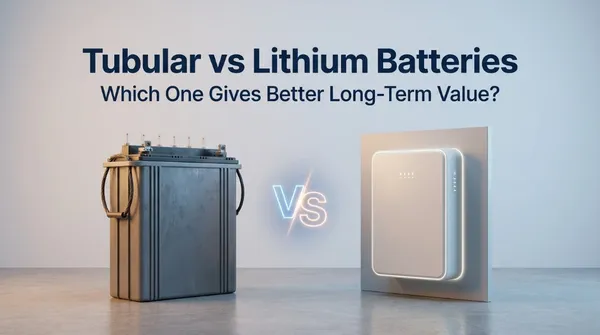
Tubular is cheaper up front and forgiving, but you use only half of it and it lasts a few years. Lithium costs more, but you use most of it, it lasts far longer, and it barely cares how fast you drain it. Spread over its life, lithium is often the cheaper choice. Our guide on making a battery last longer covers how to protect whichever you pick.
Peukert's law: draining fast costs you
There is a catch the simple formula hides. The faster you pull current from a lead-acid battery, the less total energy it gives you. This is Peukert's law.
A 200 Ah battery might deliver 20 amps for 10 hours, exactly as rated. But ask it for 100 amps and it will not last 2 hours. It might give you 35 or 40 minutes, because high current wastes energy as internal heat and resistance.
Inverter and wiring losses
The battery holds DC energy, but your appliances need AC, and converting one to the other is never free. A good inverter is 85 to 92 percent efficient, so 8 to 15 percent of your stored energy is lost as heat in the conversion. This calculator assumes about 90 percent.
Thin or long battery cables add more loss, and a weak connection wastes energy and generates heat. Short, thick, tight cables keep more of your battery where it belongs, running your home.
A worked example
Put it together for a typical evening. Say you want to run a 200 watt fridge, three 75 watt fans, and 50 watts of lights, a 475 watt load, through a four hour cut.
You need 475 watts for 4 hours, which is 1,900 Wh delivered to the load. Working backwards through 90 percent efficiency and a 50 percent tubular depth of discharge, you need about 4,200 Wh of rated battery, which is roughly a 350 Ah bank at 12 volts, or a 175 Ah bank at 24 volts. Switch to lithium and the same job needs only about 2,350 Wh of rated capacity, a much smaller and lighter bank.
How to get more backup time
Once you can see the levers, adding hours is simple. Focus on the two that move the needle most, the battery and the load.
- Add battery capacity. This is the direct lever. Twice the usable amp-hours is twice the hours, as long as your charger can refill the bank between cuts.
- Cut the load. Turn off the heavy users first. Halving your watts doubles your runtime for free.
- Choose lithium for deep, frequent use. You use most of its capacity, it shrugs off high loads, and it lasts for thousands of cycles.
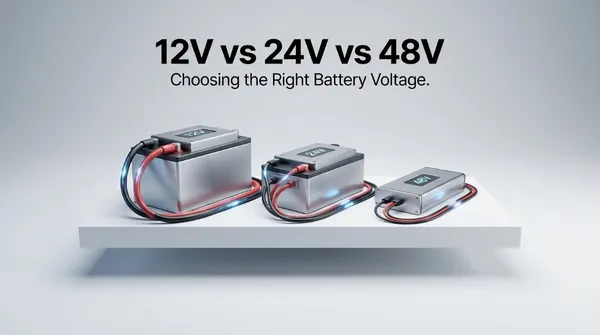
- Raise the system voltage on bigger banks. Moving from 12V to 24V or 48V cuts the current for the same power, which reduces cable and Peukert losses.
- Look after the battery. A tired or poorly charged battery never reaches its rated capacity. See our guide on making a battery last longer.
Frequently asked questions
How long will my battery last on backup?
It depends on the battery capacity, the load you run, and the battery type. As a rough guide, a 150 Ah 12V tubular battery runs a 300 watt load for around 2.5 to 3 hours. Use the calculator above for your exact numbers.
How do I calculate battery backup time?
Multiply amp-hours by volts to get watt-hours, then multiply by the safe depth of discharge and by inverter efficiency, and divide by your load in watts. That gives the runtime in hours.
Why can’t I use my battery’s full capacity?
Draining a battery too deep damages it. Lead-acid and tubular batteries should not go below about 50 percent. Lithium can safely give up 80 to 90 percent. The usable part is what decides your real backup time.
Which battery gives the longest backup?
Lithium, usually LiFePO4. You can use most of its capacity, it barely loses energy under heavy loads, and it lasts for thousands of cycles. It costs more up front but often works out cheaper over its life.
Does a bigger inverter give more backup time?
No. The inverter sets how much you can run at once. The battery sets how long it lasts. To get more hours, add battery capacity or reduce your load, not inverter size.
Why does my battery drain faster than the math says?
Real batteries lose capacity when drained fast (Peukert’s law), when they are old or cold, and through inverter and cable losses. Treat the calculated figure as a best case and size your bank with margin.
How many batteries do I need for a certain number of hours?
Work backwards. Multiply your load by the hours you want, then divide by depth of discharge and efficiency to get the rated watt-hours you need. Divide by the battery voltage for amp-hours. The calculator does this for you.
The battery is the part that decides how long your lights stay on, and the most expensive part to replace. Size it from your real load and the hours you need, respect the depth of discharge, and you will not be left in the dark halfway through a cut.