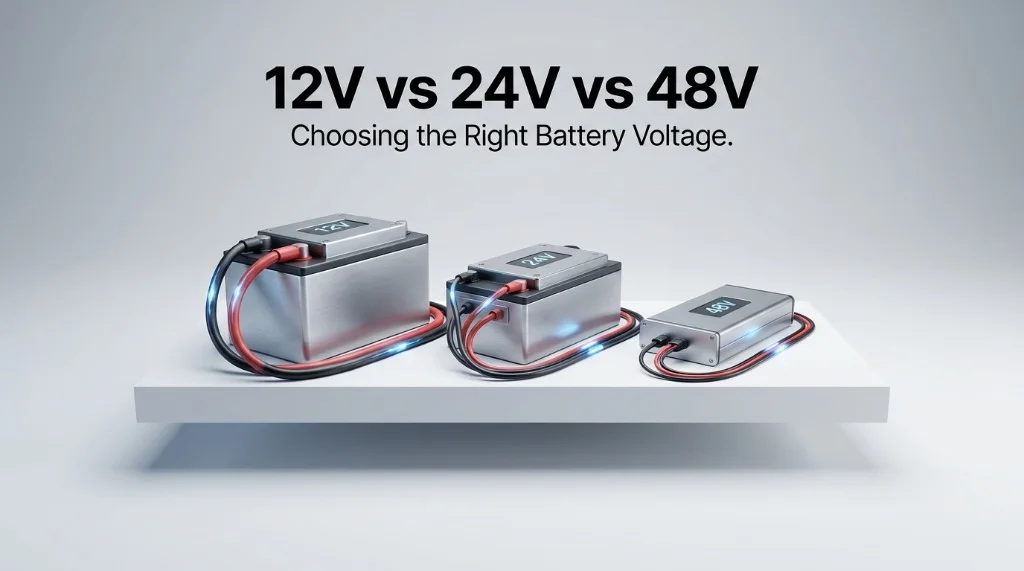
What system voltage means
System voltage is the DC voltage of your battery bank, the level the inverter draws from and the batteries are wired to reach. Home systems are built around 12V, 24V, or 48V. It is not about how much energy you store, but about how that energy is delivered to the inverter.
You reach a higher system voltage by wiring batteries in series. Two 12V batteries in series make 24V. Four make 48V. The inverter must be built for that voltage, so the choice is made when you buy the inverter, not after.
Why higher voltage means less current
Power is voltage multiplied by current. For the same power, if you raise the voltage, the current falls in proportion. Current is what forces you into thick cables and causes heat, so lowering it is a real advantage on bigger systems.
Cable size and power loss
High current is expensive and wasteful. Cables must be sized for the current they carry, so a 12V system at high power needs very thick, costly copper. Worse, the power lost as heat in a cable rises with the square of the current, written as I squared times R.
Because loss grows with the square of current, halving the current through a higher voltage cuts the cable loss to a quarter. On a large system, moving from 12V to 48V slashes both the cable cost and the energy wasted as heat. Conductor sizing and the ampacity a given cable can safely carry are set out in NFPA 70 (the National Electrical Code), Article 310.
The same 3 kW, wired three ways
Numbers make this concrete. Take one 3 kW load and supply it at each system voltage. Current is the load divided by the voltage, allowing for about 90% inverter efficiency. The cable size is what the NEC continuous load rule asks for, sized to 125% of that current in 75°C copper.
| System voltage | DC current for 3 kW | Size at 125% | Relative heat loss |
|---|---|---|---|
| 12V | ~278 A | 350 kcmil / 185 mm² | 16× |
| 24V | ~139 A | 1/0 AWG / 50 mm² | 4× |
| 48V | ~69 A | 4 AWG / 25 mm² | 1× (baseline) |
The current column is the headline, but the last column is the real argument. Because loss follows I²R, quartering the current at 48V cuts the heat wasted in the cable to a sixteenth of the 12V figure for the same delivered power. That energy is not just lost, it is heat inside a cable in your home.
The cost difference is severe too. At 12V a 3 kW system needs 185 mm² copper, which is heavy, expensive, physically hard to bend, and awkward to terminate properly. At 48V the same job takes 25 mm², a cable an electrician can actually route and crimp cleanly. This is the practical reason nobody builds a large 12V system.
12V vs 24V vs 48V at a glance
| System voltage | Best for | Current at 2 kW | Cabling |
|---|---|---|---|
| 12V | Small setups, under ~1,000 W | ~167 A | Thick, short runs only |
| 24V | Medium homes, 1,000 to 2,000 W | ~83 A | Moderate |
| 48V | Large homes, 3 kVA and above | ~42 A | Thinnest, most efficient |
Which voltage for which system
The rule of thumb follows the load. Under about 1,000 watts, 12V keeps things simple and cheap, and a single battery can run the system. From 1,000 to 2,000 watts, 24V balances cost and efficiency. Above 2,000 watts, and for anything running an air conditioner or a large pump, 48V is the practical choice.
If you expect to grow, choose the higher voltage from the start. A 48V system is also gentler on the batteries, which can help make the battery last longer. The chemistry you choose (tubular vs lithium) will also dictate your wiring strategy. Our inverter size calculator suggests a battery voltage based on your total load, so you can plan the whole system around one set of numbers.
Wiring batteries in series and parallel
Series wiring adds voltage while keeping the amp-hours the same. Two 12V 150 Ah batteries in series make a 24V 150 Ah bank. Parallel wiring adds amp-hours while keeping the voltage the same. The same two batteries in parallel make a 12V 300 Ah bank. The total stored energy is identical either way, but the system voltage is not.
Small load, 12V; medium, 24V; large or AC-capable, 48V.
Higher voltage is not about more energy, it is about delivering the same energy with less current, thinner cables, and lower losses. Pick it before you buy the inverter, because you cannot change it later without new hardware.
Frequently asked questions
Is 48V better than 12V?
For bigger systems, yes. At the same power, 48V draws a quarter of the current of 12V, so cables are thinner, losses are lower, and the wiring runs cooler. For a small lights-and-fans setup, 12V is simpler and cheaper.
Can I upgrade from 12V to 24V or 48V later?
Only with a compatible inverter and by rewiring the battery bank to the new voltage. The inverter must be rated for the new DC voltage, so plan the voltage before you buy if you expect to grow.
Does a higher system voltage give more backup time?
Not directly. The stored energy is the same. Higher voltage cuts current and cable losses, so a touch more of that energy reaches your appliances, but the big runtime lever is battery capacity, not voltage.
What system voltage do I need for a 3 kVA inverter?
Usually 24V or 48V. Larger inverters draw very high current at 12V, which needs impractically thick cables, so they are built for 24V or 48V. Systems of 3 kVA and above are best on 48V.
System voltage is one of the few choices you lock in on day one, so it pays to get it right. Size it to your load, plan for any growth, and you will run cooler, cheaper cables and waste less of the energy you worked to store.
