An inverter turns the direct current (DC) stored in your battery into the alternating current (AC) your appliances use. Get the choice right and it runs silently for a decade. Get it wrong and it either trips constantly, or it quietly cooks the motors in your fridge and air conditioner. Three numbers decide almost everything: your continuous load, your startup surge, and the power factor that separates watts from VA.
Start with your load, not the model
Before you look at a single product, add up what you actually run at the same time. That total in watts is your continuous load, and it sets the thermal limit the inverter has to live within. The mistake almost everyone makes is buying to match that number exactly, leaving no room for the surge or for the difference between watts and VA. Work out your real number first with the inverter size calculator, then shop against it.
Surge is what trips inverters
Anything with a motor, a fridge, a water pump, an air conditioner, pulls a brief inrush of three to five times its running watts when it starts. That spike can last a second or more on a large compressor. If the inverter’s surge rating cannot cover it, the overload protection trips every time the appliance cycles on. Sizing for the surge, not just the running load, is the single most common fix for an inverter that "keeps switching off."
Watts, VA, and the power factor
Inverters are sold in VA (volt-amperes), but appliances are rated in watts. The two are linked by the power factor, which is about 0.8 on a typical home. A 1,000 VA inverter really delivers around 800 usable watts. Ignore this and you undersize the system, forcing the inverter to run at full thermal capacity where it fails early. Divide your watts by 0.8 to get the VA rating to look for.
Wave type is not optional for motors
Pure sine wave inverters recreate the smooth power of the grid. Modified sine takes a blocky shortcut that motors and electronics dislike, running them hotter and shortening their life. For a home with a fridge, a pump, an AC, or a computer, pure sine is the only sensible choice. The guides below go deep on each of these decisions.
Guides in this section
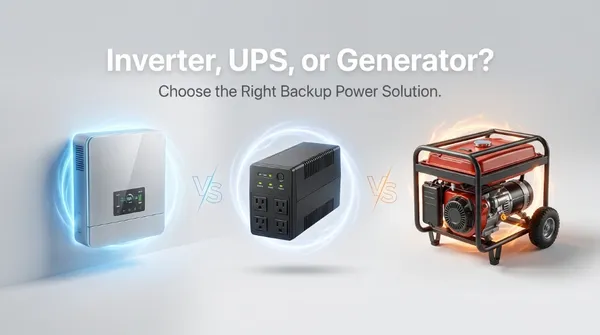
Inverter, UPS, or generator: which is best?
Three ways to keep the lights on, and which one fits your outages and your budget.
7 min read · Updated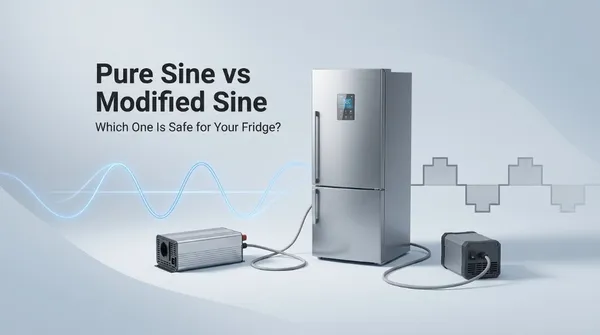
Pure sine vs modified sine: what your fridge needs
The wave shape your fridge and electronics need, and when the cheaper option is safe.
5 min read · Updated
Common inverter buying mistakes, and how to avoid them
The seven mistakes that trip inverters and waste money, and the fix for each one.
6 min read · Updated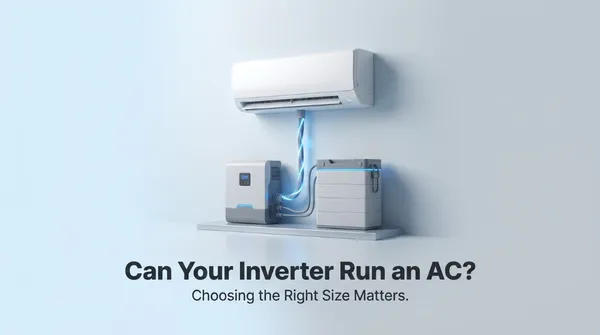
What size inverter do you need to run an air conditioner?
What it really takes to run an AC on backup, and why the battery is the hard part.
6 min read · Updated