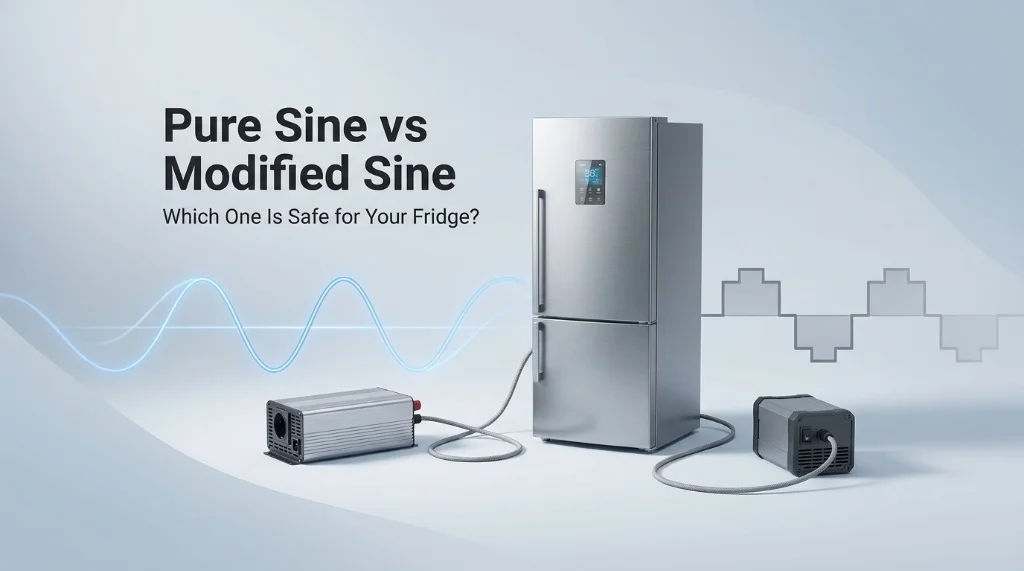
When you buy an inverter, you have to pick between two types of output: pure sine wave and modified sine wave. The pure sine one costs more. It is tempting to save money and grab the cheaper modified sine unit, and for some homes that is fine. But for others it quietly damages appliances and wastes power. This guide shows you which one your home actually needs.
Quick answer. If you run a fridge, an air conditioner, a computer, or anything with a motor, buy pure sine wave. Modified sine wave is only a safe saving on basic lights and simple fans.
What the two words mean
Mains electricity comes as a smooth wave that rises and falls gently. That smooth shape is what your appliances are designed for.
A pure sine wave inverter copies that smooth shape almost exactly. The power it gives out looks and behaves like grid power.
A modified sine wave inverter takes a shortcut. Instead of a smooth curve, it makes a rough, blocky shape with sharp steps. It is cheaper to build, but that rough shape is where the trouble starts.
Why the shape matters
Simple things do not care much about the shape. A basic light bulb or a plain fan will run on either type.
Motors and electronics are different. A fridge, a pump, or an air conditioner has a motor that expects a smooth wave. Feed it the blocky modified shape and the motor runs hotter, works harder, and wears out sooner. Sensitive electronics like computers, some TVs, and chargers can buzz, misread the power, or refuse to start. That roughness is measured as harmonic distortion, the same power-quality metric limited by IEC standards for grid-quality equipment.
The number that separates them: THD
If you want one figure to compare two inverters on a spec sheet, it is Total Harmonic Distortion (THD). It measures how much of the output is not the clean 50 Hz (or 60 Hz) wave your appliances expect. The lower the number, the closer the output is to grid power.
| Output type | Typical THD | What that means in practice |
|---|---|---|
| Utility grid | 1 to 3% | The reference every appliance is designed around. |
| Good pure sine inverter | Under 3% | Indistinguishable from the grid for any household load. |
| Budget pure sine inverter | 3 to 8% | Still safe for motors and electronics. |
| Modified sine inverter | 25 to 45% | A third or more of the output is harmonic content the motor cannot turn into rotation. |
If a datasheet does not state THD at all, that absence is itself informative. Manufacturers who have achieved under 3% put it on the front page. Look for the figure stated at full load, because THD usually worsens as the inverter is loaded up, and a number quoted at no load is close to meaningless.
Where the wasted energy actually goes
A motor produces rotation from the fundamental 50 Hz component of the wave. The harmonics stacked on top of a modified sine wave, mostly the 3rd, 5th, and 7th, are at 150 Hz, 250 Hz, and 350 Hz. The rotor cannot follow them, so instead of turning into torque, that energy is dissipated in the windings and the iron core as heat.
The practical result is a motor that draws more current for the same mechanical work, runs measurably hotter, and reaches its insulation temperature limit sooner. This is why a fridge on modified sine hums audibly, feels warm at the compressor, and typically fails years earlier than the same unit on clean power. It is also why the running cost is higher even though the inverter was cheaper.
Which appliances tolerate modified sine
| Appliance | On modified sine | Why |
|---|---|---|
| Incandescent bulb, heater, kettle | Fine | Purely resistive. It only cares about total energy, not wave shape. |
| Basic AC fan | Usually fine | Small motor, light load. Runs a little warmer and may hum. |
| LED bulb | Varies | Cheap drivers may flicker, buzz, or fail early. Quality drivers cope. |
| Laptop / phone charger | Usually works | Switch-mode supplies are tolerant, but run hotter and age faster. |
| Fridge, freezer, water pump | Avoid | Induction motor. Overheats, loses efficiency, shortens compressor life. |
| Air conditioner | No | Large compressor plus control electronics. Both suffer. |
| Inverter AC, washing machine, modern TV | No | Rely on zero-crossing detection, which a stepped wave disrupts. |
| Medical equipment (CPAP, oxygen concentrator) | Never | Manufacturers specify pure sine. Treat this as non-negotiable. |
Pure sine vs modified sine at a glance
| Feature | Pure sine wave | Modified sine wave |
|---|---|---|
| Power quality | Smooth, like the grid | Rough, blocky steps |
| Fridge, AC, pumps | Runs well, stays cool | Runs hot, wears faster |
| Computers and electronics | Safe | May buzz or misbehave |
| Efficiency | Appliances run efficiently | Motors waste power as heat |
| Price | Costs more | Cheaper |
| Best for | Any normal home | Basic lights and simple fans only |
What can go wrong on modified sine
People who buy modified sine to save money often notice the signs later. The fridge or fan hums or buzzes. Motors feel hot to the touch. Some device chargers get warm or stop working. A few appliances, like certain washing machines and some medical devices, may refuse to run at all.
None of this happens on pure sine wave, because the power is clean.
Watch out. If you already own a modified sine inverter and your fridge hums, buzzes, or gets hot, that is the inverter, not the fridge. Those appliances belong on pure sine wave.
When modified sine is actually fine
Modified sine wave is not useless. If your budget is very tight and you only need to keep a few lights and a simple fan on during a cut, it will do the job and save you money. It is also fine as a cheap temporary backup.
Only lights and basic fans, modified sine is okay. Anything with a motor or a chip in it, go pure sine.
Tip. Not sure what your setup needs? List the appliances you want to run in our inverter size calculator. If a fridge, pump, or AC is on the list, choose pure sine wave.
For almost every home, buy a pure sine wave inverter.
It costs a little more, but it protects your fridge, your electronics, and your money over time. Save modified sine for the rare case where you only ever run lights and simple fans.
Frequently asked questions
Can I run a refrigerator on a modified sine wave inverter?
You can, but you should not for long. The fridge motor runs hotter and wears out faster on modified sine. Use pure sine wave for any fridge.
Will a modified sine inverter damage my electronics?
It can shorten their life or make them behave oddly. Some electronics buzz, some chargers get hot, and a few devices will not run at all. Pure sine wave avoids this.
Is pure sine wave worth the extra cost?
For most homes, yes. The higher price is small next to the cost of a burnt-out fridge motor or a failed appliance.
How do I know which one an inverter is?
The box and the spec sheet will say pure sine wave or modified sine wave. If it does not say pure sine, assume it is modified.
The wave shape is invisible, but your appliances feel it. Pure sine wave gives clean power that keeps motors cool and electronics happy. Unless you are only running lights and simple fans, it is the type to buy.
