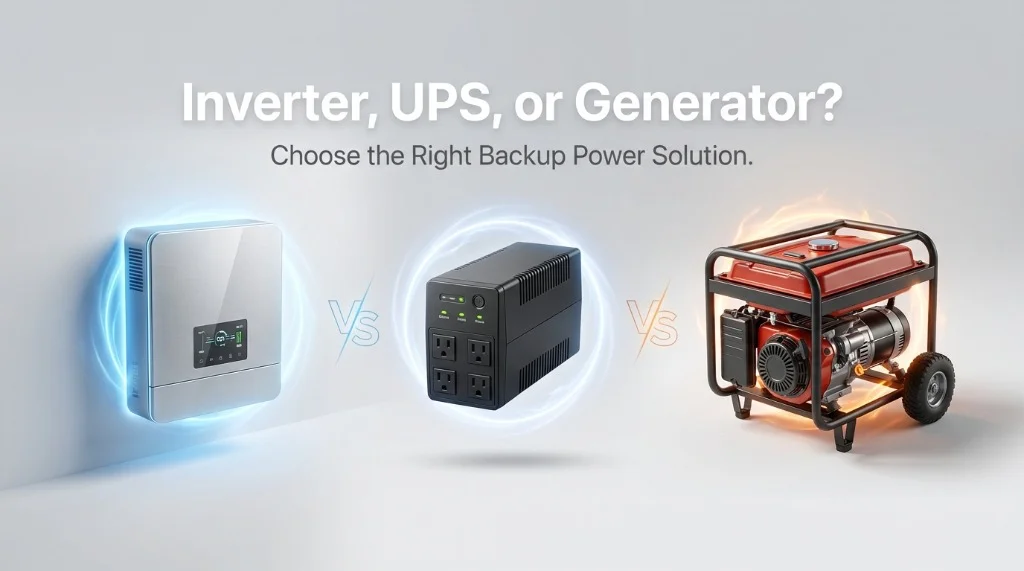
What each one actually is
A home UPS is a battery unit that switches on the instant the power cuts. The word UPS also gets used for the small box that protects a computer, but for a house it usually means a fast-switching inverter with a battery. Its main job is speed. The lights barely flicker when the power goes.
An inverter with a battery is the standard home backup in areas with daily load-shedding. It turns battery power into normal mains power for your fans, lights, TV, and fridge. Most modern home inverters switch over quickly too, so in real life the line between a home UPS and an inverter has become thin. The important part is the same: battery in, mains-quality power out.
A generator makes its own electricity by burning fuel, usually petrol, diesel, or gas. It does not need a battery and it does not run out after a few hours. As long as you keep feeding it fuel, it keeps producing power, and a bigger one can run heavy loads like an air conditioner or a whole house. Never run a generator indoors or in an attached garage: the US Consumer Product Safety Commission warns that its carbon monoxide can be fatal within minutes.
How they compare
Switch-over time. A UPS and a good inverter switch almost instantly, so your WiFi and computer stay on without a reboot. A generator takes time to start, and unless it has an automatic switch, you are in the dark until it fires up.
Running cost. An inverter and a UPS run on stored battery power, so once charged they cost almost nothing extra to use during an outage. A generator burns fuel the whole time it runs, and fuel is the biggest ongoing cost of backup power.
Noise and fumes. Inverters and a UPS are silent and clean. You can keep them indoors. A generator is loud and produces exhaust fumes, so it has to sit outside with air around it, never in a closed room.
Capacity. This is where a generator wins. A large generator can run an air conditioner, a water pump, and the whole house at once. An inverter and battery are limited by battery size, and running heavy loads drains them fast.
Maintenance. Inverters need little care beyond looking after the battery. Generators need real upkeep: oil changes, filters, fuel that goes stale if it sits, and regular test runs.
Upfront cost. A basic UPS or small inverter with a battery is the cheapest way to keep lights and fans on. A big generator costs more to buy, and lithium battery systems for inverters also cost more, but they last longer.
Side by side on the specs that decide it
| Home UPS | Inverter + battery | Generator | |
|---|---|---|---|
| Switch-over time | 3 to 10 ms | 10 to 20 ms typical | 10 to 30 seconds (manual: minutes) |
| Typical home capacity | 0.6 to 1.5 kVA | 1 to 10 kVA | 2 kVA to whole-house |
| Runtime limit | Battery only | Battery only | As long as there is fuel |
| Can it run an AC? | No | Yes, if sized for it | Yes |
| Noise | Silent | Silent | 60 to 90 dB |
| Exhaust fumes | None | None | Yes. Outdoors only, never indoors |
| Indoor safe | Yes | Yes (ventilate flooded batteries) | Never |
| Maintenance | Battery only | Battery, water top-ups if flooded | Oil, filters, plugs, fuel, test runs |
| Refuelling during an outage | Not needed | Not needed | Required for long outages |
| Life expectancy | Battery 3 to 5 yrs | Inverter 8 to 12 yrs, battery 3 to 15 yrs | Engine 10+ yrs with servicing |
Noise: read the decibel rating before you buy
Noise is the complaint that turns up after installation, not before, and it is the one spec people skip. Every generator has a decibel rating printed in its datasheet, usually measured at 7 metres. A number around 60 dB is roughly normal conversation; 75 dB is a vacuum cleaner running next to you; 90 dB is genuinely unpleasant and well past what most neighbourhoods tolerate at night.
Two cautions when comparing figures. First, decibels are logarithmic, so 75 dB is not "a bit louder" than 65 dB, it is about twice as loud to the ear. Second, check the measurement distance: a rating quoted at 7 metres will look far better than the same machine quoted at 1 metre, and manufacturers are not consistent about which they publish. An inverter and a UPS have no rating to compare because they have no engine, only a small cooling fan, which is why they can live indoors in a bedroom or an office.
Switchover time and the automatic transfer switch
How quickly power comes back is a real difference, not a detail. A UPS switches in a few milliseconds, fast enough that a computer never notices. A home inverter typically takes 10 to 20 milliseconds, which lights and fans ride through comfortably but a desktop PC may not. A generator has to crank, start, and stabilise, so you are looking at 10 to 30 seconds of genuine darkness even on an auto-start model.
That last case is where an automatic transfer switch (ATS) comes in. An ATS is a contactor that senses the mains has failed, signals the generator to start, and physically moves your load from the utility supply to the generator, then reverses the sequence when the grid returns. Its second job matters more than its convenience: because the switch is mechanically interlocked, your generator can never be connected to the utility at the same time as the mains. That is what prevents backfeed onto the street, which is the hazard that injures line workers.
NEC 702.5 requires this separation on any permanently connected standby supply. A manual changeover switch satisfies it too, and costs far less, but it only works if someone is home to throw it. What is never acceptable is a suicide cord backfeeding a wall socket. Most home inverters have the equivalent function built in as an internal transfer relay, which is why they need no external switch, though a permanently wired installation still needs a licensed electrician.
The running-cost gap is the part people miss
Buying price is only half the decision. What separates these three over five years is their total cost of ownership, meaning what they cost to operate on top of what you paid, and the gap is large.
A generator burns fuel by the hour. The fuel consumption rate is the figure to find on the datasheet, usually quoted in litres per hour at 50% and 100% load. A small petrol set producing about 2 kW typically consumes somewhere around 1 to 1.5 litres an hour under load. Four hours of load-shedding a day is roughly 4 to 6 litres daily, and that is before oil changes and servicing. Multiply by your local fuel price and it becomes a significant monthly line item that never goes away.
An inverter's "fuel" is grid electricity, and far less of it. Recharging a battery that delivered 2 kWh costs you roughly 2.4 to 2.8 kWh from the grid, because charging and conversion are around 75 to 85% efficient end to end. At normal tariff rates that is a small fraction of the fuel cost for the same energy.
The battery is the real recurring cost. Treat it as a consumable and divide its price by the years it will realistically last. A tubular bank replaced every three to four years can, over a decade, cost more than a lithium bank bought once. That is the calculation to run, rather than comparing sticker prices. Our guide on tubular vs lithium batteries works through the cost per usable kilowatt-hour.
Which one is right for you
Choose an inverter with a battery if you face daily load-shedding for a few hours and want to keep the essentials running: lights, fans, the TV, WiFi, and the fridge. It is silent, clean, and cheap to run, and for most homes it is the right answer. Use our inverter size calculator to find the size you need, and the battery backup-time calculator to see how many hours it will last.
Choose a home UPS if your main worry is that quick flicker, and you mostly need computers, WiFi, and lights to stay on without interruption. In practice a good inverter does this job too, so do not pay extra for the UPS label alone.
Choose a generator if your outages last many hours, or you must run heavy loads like air conditioners or a water pump for a long time. Just accept the noise, the fumes, and the fuel bill that come with it.
Many homes end up using both. An inverter handles the daily short cuts quietly, and a generator is kept for long outages or for running the AC when needed. There is nothing wrong with that mix.
A simple way to decide
Ask yourself two questions. How long do your outages last, and how heavy is the load you need to run?
If the answer is short outages and light loads, an inverter with a battery is almost always the best choice. If the answer is long outages or heavy loads like an AC, a generator earns its place, on its own or alongside an inverter.
Frequently asked questions
Is an inverter the same as a UPS?
For a home they now do almost the same job. Both switch to battery power when the mains fails. A UPS is built for very fast switching to protect electronics, but most modern inverters switch fast enough for normal home use.
Can an inverter run an air conditioner?
A small one cannot. You need a larger pure sine wave inverter and a strong battery bank, and even then the backup time is short. For running an AC through a long outage, a generator is usually the practical choice.
Is a generator cheaper than an inverter?
It can be cheaper to buy for the power it gives, but it is more expensive to run because of fuel, and it needs maintenance. An inverter costs more to set up with batteries but almost nothing to run.
Which is better for daily load-shedding?
For daily cuts of a few hours, an inverter with a battery is usually best. It is silent, clean, and cheap to run, and it starts instantly.
The bottom line
There is no single winner. An inverter suits daily short outages, a generator suits long or heavy ones, and a UPS is really just a fast inverter. Match the tool to how long your power goes and how much you need to run, and you will not waste money. When you are ready, size your inverter with the inverter size calculator.
