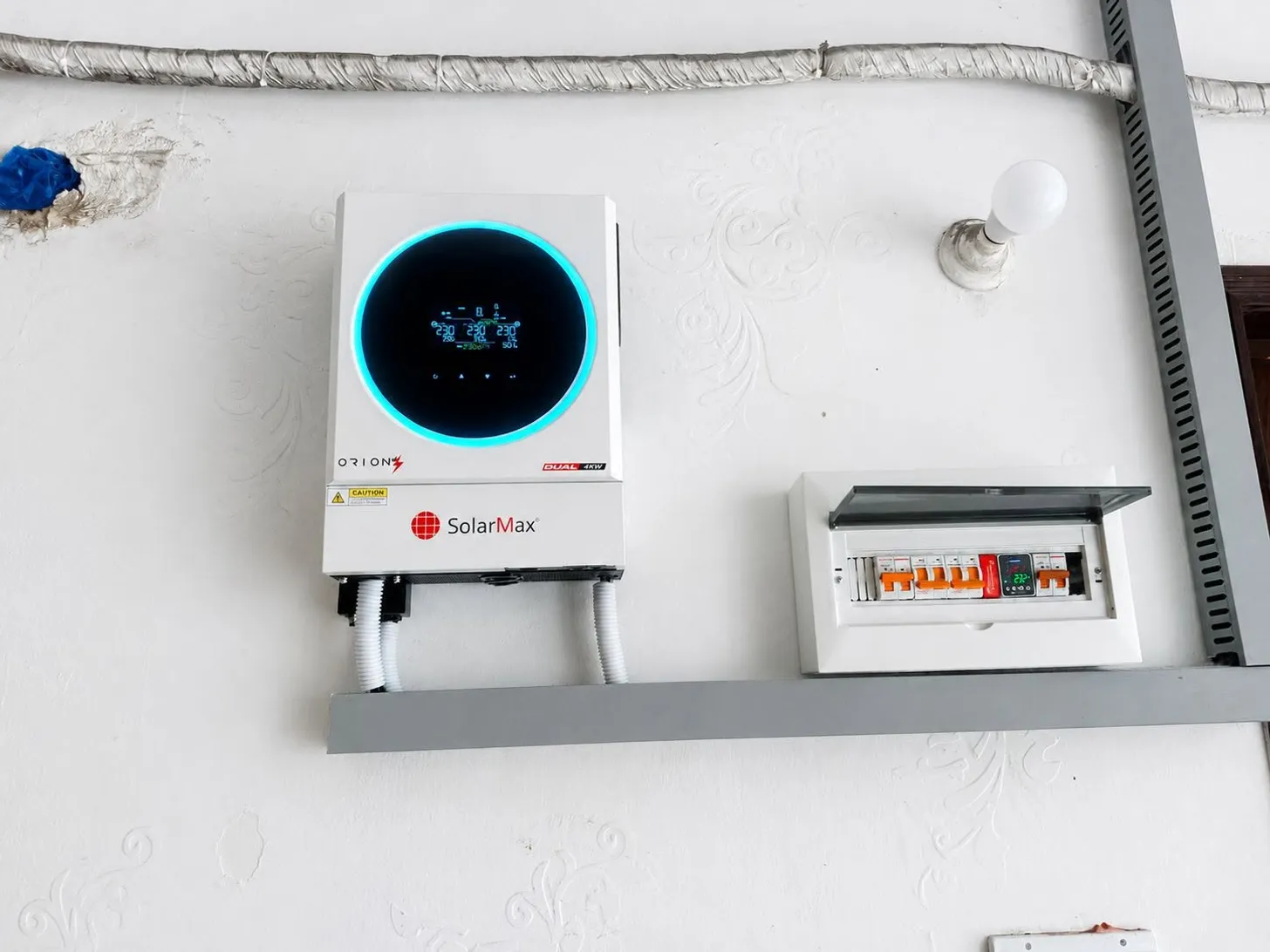
Most of this site is theory: how to size an inverter, why surge trips a cheap unit, how much of a battery you can really use. This is one of the places we put that theory next to a system that is actually running. The photo above is the finished inverter wall in this install, taken on handover, with the inverter live and reading 230 V at 50 Hz.
The system at a glance
This is a grid-hybrid setup, meaning the inverter runs the home from solar and battery, tops the battery up from panels or grid as needed, and falls back to the grid when it has to. The core hardware:
| Part | What we used |
|---|---|
| Inverter | SolarMax ORION DUAL 4 kW hybrid |
| Panels | 10 × LONGi Hi-MO X 645 W (6,450 W total) |
| Battery | Epever lithium (LiFePO4) |
| Protection | DC and AC MCBs plus a digital over/under-voltage protector on the board |
| Output | 230 V, 50 Hz single phase |
The inverter and the distribution board sit side by side on a steel channel, with the cable runs carried in flexible conduit down into the board. Keeping the inverter and the board next to each other keeps the AC runs short, which is what you want: short runs mean thinner cable and smaller voltage drop.
Why a 6.45 kW array on a 4 kW inverter
The first thing an engineer notices here is that the panels add up to 6,450 W while the inverter is rated 4 kW. That is a DC-to-AC ratio of roughly 1.6 to 1, and it is a deliberate choice, not a mistake.
Panels almost never make their rated power. They hit the number on the label only in cool, bright, midday conditions with the sun square to the glass. For most of the day, in heat, haze, or low winter sun, they make far less. Sizing the array well above the inverter means the system still pushes strong output in the morning, the late afternoon, and on cloudy days, and it charges the battery faster when the sun is weak. On a clear summer noon the array can produce more than the inverter can pass, and the surplus is simply clipped. Losing a little peak that you would rarely reach is a good trade for gaining a lot of energy across the whole day.
The board and its protection
To the right of the inverter is the distribution board, and it is worth a close look because it is where a lot of installs cut corners. This one has proper MCBs for the circuits and, in the middle, a digital over/under-voltage protector, the unit with the red readout.
At the moment the photo was taken, that protector was reading a grid voltage up in the 270s, well above the 230 V nominal. That is exactly why it is there. When the grid swings high, and in many areas it does, an unprotected inverter and the appliances behind it take the hit. The protector watches the voltage and disconnects the load if it climbs too high or drops too low, then reconnects once it settles. On a real grid this is not a luxury, it is what keeps the expensive box on the wall alive.
For the deeper reasoning on protection and wiring, our inverter sizing guide covers DC breakers, fusing at the battery, and why a transfer switch is non-negotiable on any circuit tied into house wiring.
What a system this size generates
We do not want to overstate figures we have not logged over a full month, so treat this as an estimate from the array size, not a measured result. Using the same method as our solar sizing guide: a 6.45 kW array, at around five peak sun hours and roughly 80% system efficiency, works out to about 26 kWh on a good day. Shorter winter days and heavy cloud pull that down, which is again why the array is sized generously against the 4 kW inverter.
How much of that energy carries the home through the evening and any outage depends on the battery, not the panels or the inverter. The lithium bank here is what sets the backup time. To see how battery capacity, depth of discharge, and load turn into real hours, run the numbers in the battery backup time calculator.
What we would confirm on a site visit
Being honest about a photo write-up: there are figures we would measure before signing off on a system like this, and they are the numbers we will add to these notes as we log them.
- The battery's usable capacity in kWh, and the backup time it actually delivers under the home's evening load.
- A clamp-meter reading of the largest motor start in the house, to confirm the 4 kW inverter has the surge headroom for it.
- The PV string voltage on a cold morning, checked against the inverter's MPPT ceiling.
- A month of generation data, to replace the estimate above with a measured daily average.
That is the difference between a spec sheet and a commissioned system, and it is the part we care about most.
