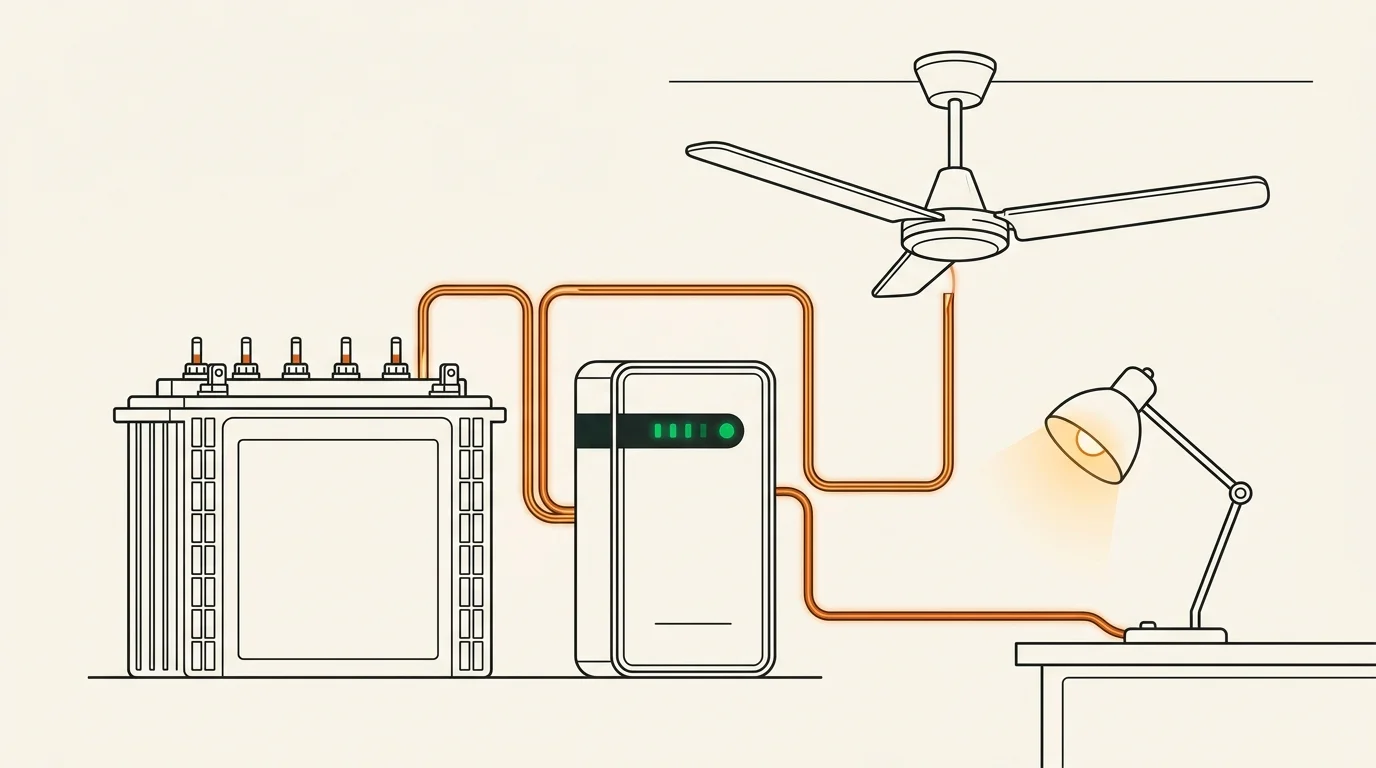
The real math behind 150Ah and 200Ah backup hours
Two traps distort most online backup-time claims: assuming you can use 100% of a lead-acid battery's capacity, and ignoring the ~10% power lost inside the inverter converting 12 V DC into 230 V / 120 V AC.
Ah × Voltage × Safe Depth of Discharge × 0.90 Inverter Efficiency.• 12 V 150 Ah Tubular (50% DoD): 150 × 12 × 0.50 × 0.90 = 810 Wh usable
• 12 V 200 Ah Tubular (50% DoD): 200 × 12 × 0.50 × 0.90 = 1,080 Wh usable
• 12.8 V 200 Ah LiFePO4 (90% DoD): 200 × 12.8 × 0.90 × 0.90 = 2,074 Wh usable
150Ah vs 200Ah backup time chart (100 W to 800 W loads)
The table below assumes new, fully charged batteries at ~25°C room temperature and ~90% inverter conversion efficiency. Above ~350 W on a single 12 V tubular battery, Peukert losses pull actual runtime below simple linear math:
| Continuous AC load | 12 V 150 Ah Tubular (1 battery) | 12 V 200 Ah Tubular (1 battery) | 24 V 200 Ah Tubular (2 batteries) | 12.8 V 200 Ah LiFePO4 (1 pack) |
|---|---|---|---|---|
| 100 W (Lights + WiFi + 1 fan) | ~8.1 hrs | ~10.8 hrs | ~21.5 hrs | ~20.5 hrs |
| 200 W (2 fans + lights + TV) | ~4.0 hrs | ~5.4 hrs | ~10.8 hrs | ~10.3 hrs |
| 300 W (Fridge avg + fans + lights) | ~2.5 hrs | ~3.5 hrs | ~7.2 hrs | ~6.9 hrs |
| 500 W (Home office + fridge + 3 fans) | ~1.1–1.3 hrs (Peukert drop) | ~1.7–2.0 hrs | ~4.1 hrs | ~4.1 hrs |
| 800 W (Heavy load / small pump) | ~35–45 mins (sag risk) | ~55–65 mins | ~2.4 hrs | ~2.5 hrs |
Want exact numbers for your own custom load mix, inverter efficiency, or a 48 V bank? Plug them into our Battery Backup Time Calculator.
Why heavy loads drain a 12 V tubular battery faster than expected
Tubular lead-acid capacity ratings are measured at a slow 10-hour or 20-hour discharge rate (C10 or C20 — roughly 7.5 A to 20 A). When a 600 W home load pulls ~55 amps DC from a single 12 V battery, internal resistance turns much of that capacity into heat—a phenomenon called Peukert's law.
Moving to a 24 V system (two batteries in series) cuts that DC current in half for the exact same AC wattage, rescuing your runtime and dramatically extending plate life. Equally important: sizing thick DC battery cables prevents voltage sag from triggering an early inverter low-battery shutdown—and if you plan to run heavy winter heating loads, check how fast a 1,500 W space heater drains 12V vs 48V batteries.
Worked backup scenarios for everyday homes
- Apartment essentials (~220 W): Two ceiling fans (150 W), four LED bulbs (40 W), WiFi router (15 W), and phone chargers. A single 12 V 150 Ah tubular battery covers a 3.5-hour evening cut cleanly; 200 Ah stretches comfortably past 4.5 hours.
- Full family evening with refrigerator (~420 W average): Refrigerator cycling (~200 W avg load, keep surge checked in Inverter Size Calculator), three ceiling fans, TV, and lights. One 12 V tubular will struggle to pass 1.5–2 hours cleanly; upgrade to 24 V dual 180–200 Ah tubular (~5 hrs) or a lithium pack. Compare economics in Tubular vs Lithium Batteries.
Expect ~810 Wh usable from 12V 150Ah tubular, ~1,080 Wh from 200Ah tubular, and ~2,070 Wh from 200Ah LiFePO4.
Protect lead-acid longevity by stopping around 50% discharge (battery care checklist), or double your daily usable runtime with lithium.
Frequently asked questions
How many hours does a 150Ah tubular battery last on 2 fans and 4 lights?
Two standard ceiling fans (2 × 75 W = 150 W) plus four 10 W LED bulbs (~40 W) and a WiFi router total ~200 W. On a healthy 12 V 150 Ah tubular battery (810 Wh usable at 50% DoD and 90% efficiency), expect roughly 4 hours of safe backup.
Is a 200Ah battery worth upgrading to from 150Ah?
Yes, for nearly every load above 200 W. Moving from 150 Ah to 200 Ah adds 33% rated amp-hours, and reduces Peukert voltage sag under heavier currents, often giving 35% to 45% more practical runtime.
Why does a 150Ah lithium battery last almost twice as long as a 150Ah tubular battery?
A tubular lead-acid battery should only be discharged to 50% (75 Ah usable) to avoid rapid sulfation, whereas a 12.8 V LiFePO4 lithium battery safely delivers ~90% (135 Ah usable) without Peukert losses.
Can one 12V 200Ah battery run an air conditioner?
Not safely or reliably. Even a modulated 1-ton inverter AC draws ~800–1,000 W (~75–90 A from a 12 V battery), pushing a single 200 Ah lead-acid battery into rapid voltage sag and low-voltage cut-off within 35 to 60 minutes. Run ACs on 24 V or 48 V systems.
