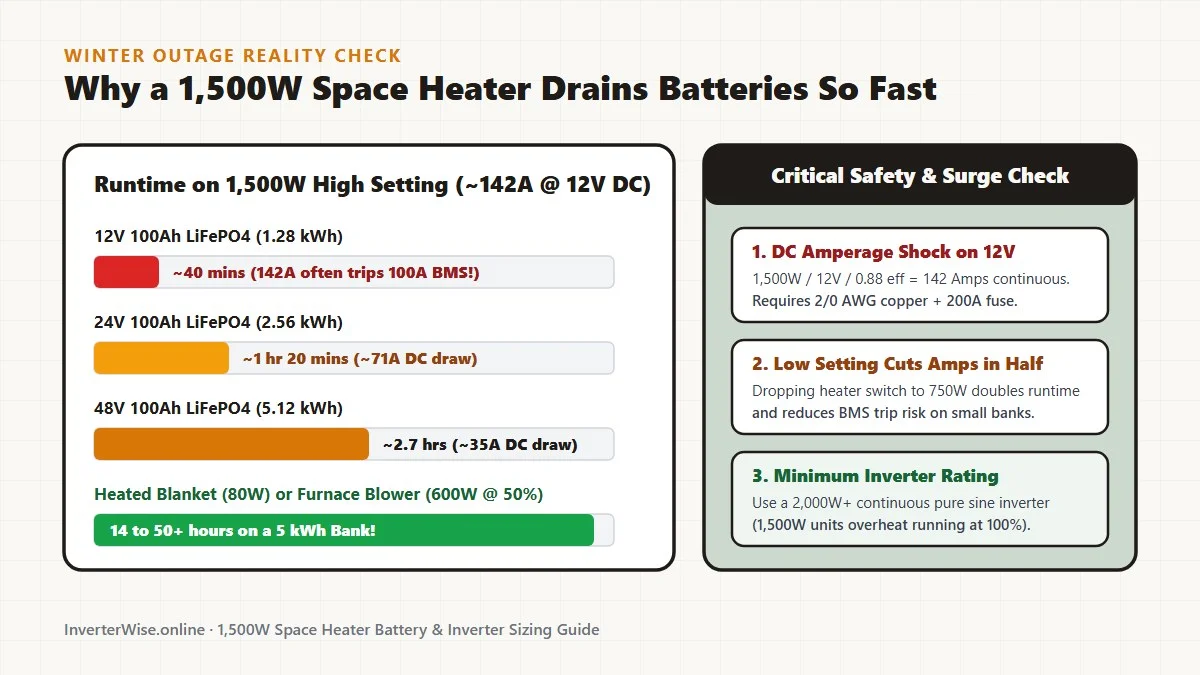
Why 1,500W shocks 12V batteries and inverters
Plug-in space heaters are simple resistive coils drawing nearly unity power factor (1.0), meaning a 1,500 W dial consumes the full 1,500 W nonstop whenever the thermostat calls for heat. Unlike a 200 W refrigerator or fan load that runs gently, turning electrical watts into heat pulls heavy DC current from low-voltage banks:
DC Amps = AC Watts ÷ Battery Volts ÷ Inverter EfficiencyAt 1,500 W on a 12 V battery (88% efficiency):
1,500 ÷ 12 ÷ 0.88 = 142 Amps continuous!Most popular 12V 100Ah lithium batteries contain an internal 100A Battery Management System (BMS). Pulling 142A trips overcurrent protection in seconds.
Exact runtime table: 1,500W (High) vs 750W (Low)
Assuming 88% inverter efficiency, 90% usable depth of discharge for LiFePO4, and 50% usable depth of discharge for deep-cycle AGM/tubular lead-acid (which also suffers severe Peukert sag under high discharge):
| Battery bank | Total vs usable kWh | Runtime @ 1,500W High | Runtime @ 750W Low |
|---|---|---|---|
| 12V 100Ah AGM / Flooded lead-acid | 1.20 kWh / ~0.53 kWh (Peukert reduced) | ~15–20 min (voltage collapses) | ~35–45 min |
| 12V 100Ah LiFePO4 (1 pack) | 1.28 kWh / ~1.01 kWh | ~40 min *(needs 150A+ BMS)* | ~1.3 hrs (~71A DC) |
| 12V 200Ah or 24V 100Ah LiFePO4 | 2.56 kWh / ~2.03 kWh | ~1 hr 20 min | ~2.7 hrs |
| 48V 100Ah LiFePO4 (server rack) | 5.12 kWh / ~4.05 kWh | ~2.7 hrs (~35A DC) | ~5.4 hrs (~18A DC) |
| 10 kWh 48V LiFePO4 bank | 10.24 kWh / ~8.11 kWh | ~5.4 hrs | ~10.8 hrs (overnight in 1 room) |
Test your specific battery Ah, voltage, and thermostat cycling hours in our Battery Backup Time Calculator.
Inverter rating, cable size & safety checks
- Minimum 2,000W continuous inverter: Never connect a 1,500 W heater to a 1,500 W inverter—MOSFETs running at 100% thermal output shut down quickly. Step up to at least a 2,000 W unit.
- Step up system voltage or parallel packs: Pulling 1,500 W from 12 V requires thick 2/0 AWG (70 mm²) short copper cables and a 200 A fuse, plus two 12V 100Ah batteries wired in parallel (or a 24V or 48V system) so DC current stays comfortably within ratings. Always confirm lead thickness in the DC Cable Size Calculator.
Much better ways to survive winter outages on batteries
Unless you already own 15–30 kWh of whole-home lithium storage, stop trying to heat whole rooms from batteries directly:
- Run your gas/propane furnace fan (~500 W cycling): If your home heats with natural gas or propane, wiring a transfer circuit to power the 120V gas furnace blower delivers whole-home warmth for 15–20 hours on a single 5 kWh battery.
- Use a 12V / 120V electric heated blanket (60–100 W): Warms sleepers inside a tent or bedroom for 10–15 hours on a tiny 1 kWh battery.
- Drop to 500W–750W Low in a closed room: Keep one small bedroom above freezing instead of running 1,500 W into an open living room.
Check every heater and winter appliance's daily kWh impact with our Appliance Wattage Calculator.
Frequently asked questions
How long will a 12V 100Ah LiFePO4 battery run a 1,500W space heater?
About 40 minutes in total—if the battery BMS does not trip first. A 12.8V 100Ah lithium battery holds 1,280Wh (~1,020Wh usable after 90% inverter efficiency). At 1,500W continuous, you pull ~142 amps DC from a battery typically capped at 100A continuous BMS discharge, triggering an instant shutoff.
What size inverter do I need for a 1,500 watt space heater?
Buy at least a 2,000W continuous pure sine or modified sine inverter—never a 1,500W unit. Running a 1,500W heater flat-out on a 1,500W inverter drives MOSFET temperatures to maximum rating and causes thermal shutdowns within minutes.
How long does a heater last on the 750W Low setting?
Switching a portable heater from High (1,500W) to Low (750W) cuts current draw in half (~71A at 12V DC). That brings the load safely below a single 100A lithium BMS limit and roughly doubles runtime: ~1.3 hours on a 12V 100Ah LiFePO4, or ~2.7 hours on a 24V 100Ah bank.
Why is running a gas furnace blower better than a space heater during outages?
An electric space heater creates heat from electricity (1,500W all night = 15+ kWh). A natural gas or propane furnace uses fuel for heat and draws only ~500W for the 120V air blower fan cycling on and off—lasting 4 to 6 times longer on the exact same battery bank.
