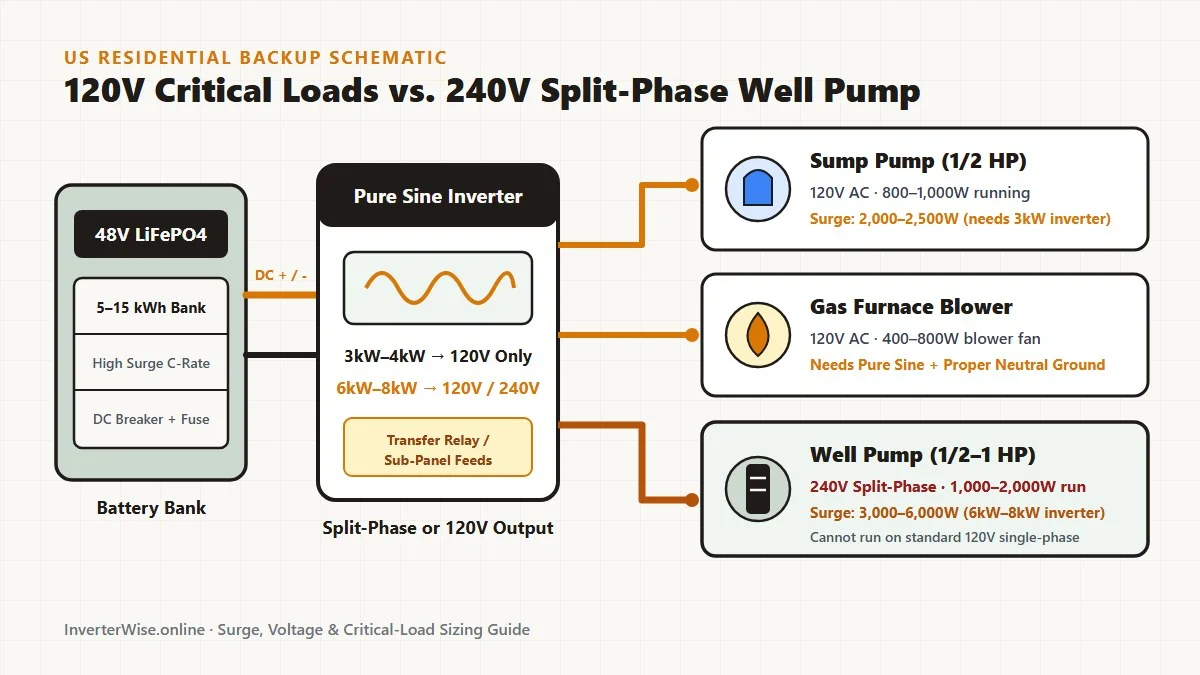
Running watts & startup surge chart (US home critical loads)
Every induction motor draws a brief Locked-Rotor spike the instant power closes. Always compare both columns—an inverter rated for the steady wattage alone will trip on overload the first time the float switch rises:
| Appliance | Nominal voltage | Running watts | Startup surge |
|---|---|---|---|
| Refrigerator / freezer | 120 V | 150 – 300 W | 800 – 1,200 W |
| Gas furnace blower fan | 120 V | 400 – 800 W | 800 – 1,500 W |
| Sump pump (1/3 HP) | 120 V | 600 – 800 W | 1,500 – 2,000 W |
| Sump pump (1/2 HP) | 120 V | 800 – 1,000 W | 2,000 – 2,500 W |
| Submersible well pump (1/2–1 HP) | 240 V | 1,000 – 2,000 W | 3,000 – 6,000 W |
Sump pump sizing: why 1,500W inverters trip
A flooded basement happens the moment power goes out during heavy rain. Many homeowners see "800 W" on a 1/2 HP sump pump cord and try buying a 1,200 W or 1,500 W car inverter. Within milliseconds of the float rising, the pump pulls 2,000 W to 2,500 W of locked-rotor current; high-frequency budget inverters sag and shut off instantly, leaving the pit to overflow.
A heavy-duty 2,000 W low-frequency or 3,000 W pure sine wave inverter ensures the pump launches even if the refrigerator compressor is already running at 200 W. Test your combined loads in the Inverter Size Calculator before sizing cables.
Gas furnace blowers & flame-sensor errors
A natural gas or propane furnace does not use electricity to make heat—it uses 120 V power only for the electronic ignition board, inducer motor, and air blower fan (typically 400 W to 800 W running, or much lower on ECM variable-speed blowers). However, gas furnaces are notoriously picky about backup power:
- Pure sine wave required: Square or modified sine waves heat up PSC blower motors and disrupt igniter control logic.
- Neutral-ground reference for flame sensors: Gas furnace flame rectification sends a tiny microamp DC signal through the burner flame to verify combustion. If your portable inverter floats its neutral without an external bonding path (when run standalone rather than wired to a bonded sub-panel), the board throws an ignition fault. Check our neutral bonding guide for wiring rules.
The 240V well pump bottleneck
Shallow jet pumps (120 V) behave much like sump pumps. Deep submersible well pumps, however, almost universally wire across a two-pole 240 V breaker. A single 120 V inverter cannot feed 240 V circuits.
If running running water from your well is mandatory during multi-day outages, you need a 6,000 W to 8,000 W split-phase (120V/240V) hybrid or off-grid inverter paired with a 48 V lithium bank capable of sustaining a 4,000 W–6,000 W two-second surge without tripping the battery's internal BMS overcurrent limit.
How big a battery bank for overnight storms?
Unlike constant lighting loads, pumps and furnaces run intermittently (on a duty cycle). Always compute watt-hours using actual runtime minutes rather than peak nameplate draw:
3.0 kWh + Fridge (200 W cycling 35%) = 0.84 kWh + Sump pump running 8 min/hr at 900 W = 1.44 kWh + WiFi & LEDs = 0.5 kWh → Total = ~5.8 kWh. Allowing for inverter efficiency (~90%) and lithium depth of discharge, one 5 kWh to 10 kWh 48V LiFePO4 module protects a home comfortably overnight.
Run your exact hours per day in the Appliance Wattage Calculator, size battery runtime with the Battery Backup Time Calculator, and pick heavy copper DC leads using our DC Cable Size Calculator.
Frequently asked questions
What size inverter do I need for a 1/2 HP sump pump?
A typical 1/2 HP 120V sump pump draws 800W to 1,000W continuously while pumping, but demands 2,000W to 2,500W of starting surge for roughly one second. Choose at least a 2,000W low-frequency or 3,000W pure sine wave inverter so it starts cleanly every float cycle—even when a refrigerator is also running.
Can a 120V inverter run a 240V submersible well pump?
No. Standard 120V portable inverters cannot power a 240V two-pole well pump breaker. You need a 240V split-phase inverter rated around 6,000W to 8,000W (with sufficient surge capacity for 3,000W–6,000W locked-rotor well pump starts) or two stackable 120V inverters wired in split-phase.
Does a gas furnace blower need a pure sine wave inverter?
Yes. Modern gas and oil furnace control boards monitor flame rectification sensors and variable-speed ECM blower drives that overheat, hum, or throw ignition lockouts on modified sine wave power. Use a pure sine wave inverter and verify proper neutral-ground referencing.
How long will a battery run a sump pump and furnace during a power outage?
If a 120V gas furnace averages 500W at a 50% winter duty cycle (~250W average = 6 kWh/day) and a sump pump cycles 10 minutes per hour (~150W average = 3.6 kWh/day), you consume roughly 10 kWh every 24 hours. A 48V 200Ah (10.24 kWh) LiFePO4 battery bank provides about 18–20 hours of realistic protection before recharging.
