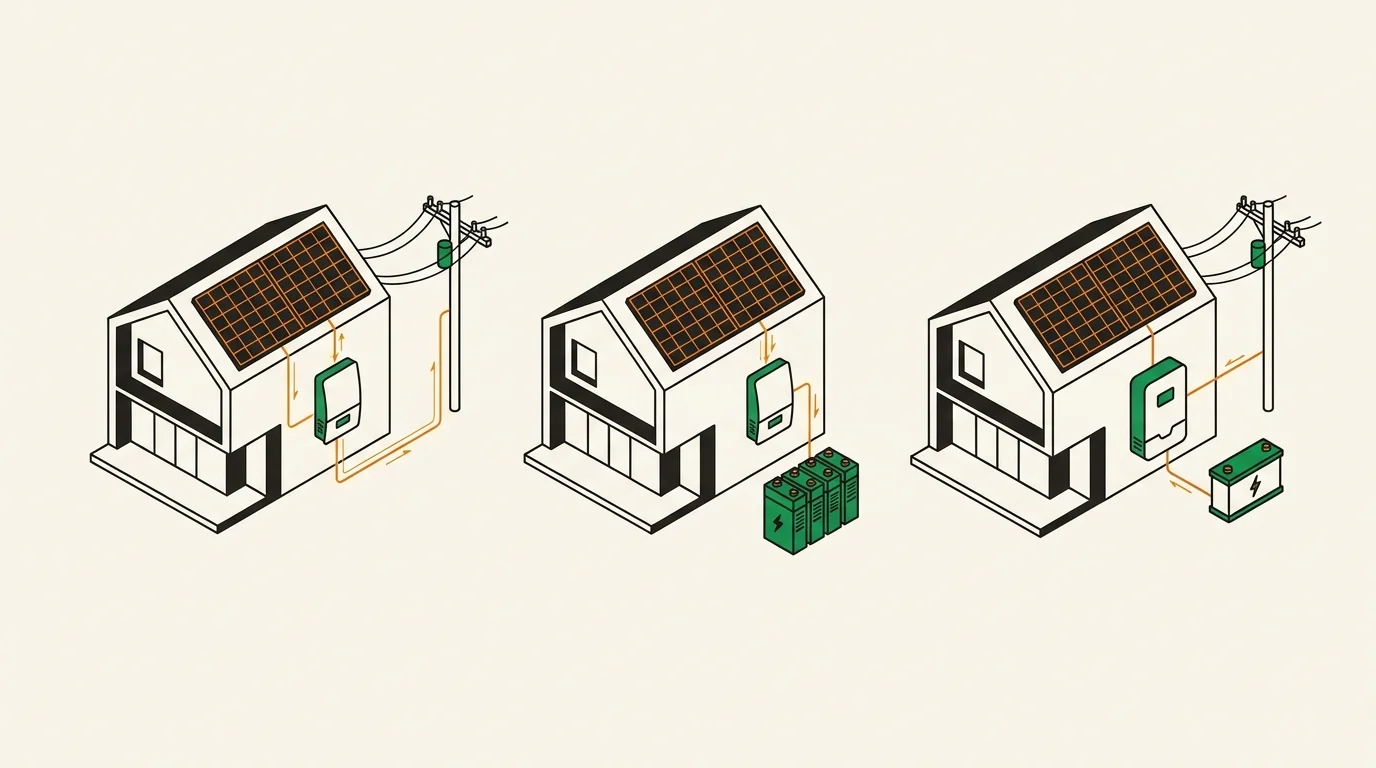
How the three solar inverter architectures differ
Many homeowners only notice the label difference after installation—most dramatically the first afternoon utility power drops out and an on-grid system shuts down completely despite bright midday sun.
- On-grid (grid-tied) inverter: Connects solar panels straight to your main utility panel with no battery bank. Daytime power runs home loads first and pushes surplus power into the grid (recorded as EX export units on bidirectional meters).
- Hybrid inverter: Combines solar MPPT charging, a bidirectional utility port, and a 48 V or 24 V battery bank with a built-in fast transfer switch (~10 ms). It supplies backup during outages and can export excess solar power where permitted.
- Off-grid solar inverter: Built purely around a battery bank and solar panels for cabins, farms, or zero-export sites. Some cheaper "hybrid-labelled" off-grid inverters (commonly sold as Axpert/MPPT clones) include an AC utility charger input, yet cannot feed surplus solar back into the utility grid.
Hybrid vs on-grid vs off-grid side-by-side
| Feature | On-Grid (Grid-Tied) | Hybrid (Grid + Battery) | Off-Grid (Stand-Alone) |
|---|---|---|---|
| Works during grid outage? | No (shuts off immediately) | Yes (~10 ms seamless transfer) | Yes (independent of grid) |
| Needs batteries? | No | Yes (optional on some models, recommended for backup) | Mandatory (multi-day bank) |
| Net metering export? | Yes | Yes (true IP65 / grid-tie hybrids) | No (zero-export / charge only) |
| Upfront cost | Lowest (no battery expense) | Medium–High (inverter + battery) | Highest per kWh delivered |
| Typical lifespan | 10–15 years | 10–12 years (plus battery cycles) | 5–10 years (depends on battery care) |
| Ideal use case | Stable grids with high bills | Load-shedding areas + bill savings | Remote properties without grid lines |
Why an on-grid inverter turns off during load-shedding
Buyers often feel cheated when they hear their rooftop panels produce zero watts during a noon outage. That behaviour is a mandatory safety law known as anti-islanding protection (IEEE 1547 / IEC 62116). Because an on-grid inverter has no physical transfer relay isolating your home from the street lines, staying online during a blackout would energize neighborhood wires and risk electrocuting utility linemen.
A true hybrid inverter solves this safely using internal mechanical relays that physically disconnect the utility grid side within ~10–15 milliseconds while keeping your protected home sub-panel alive from panels and batteries—just like the changeover layout shown in our 10 kW Lahore hybrid installation notes.
Which inverter type should you choose?
- Pick Hybrid when blackouts happen weekly: Whether it is 2-hour scheduled load-shedding or unplanned feeder faults, a 5 kW to 10 kW pure sine hybrid inverter paired with LiFePO4 storage keeps fridges, fans, WiFi, and even a 1-ton or 1.5-ton inverter AC running effortlessly.
- Pick On-Grid when outages are rare and expensive AC bills dominate: You skip the upfront battery cost completely and achieve the fastest simple payback (often 2.5–3.5 years). If you still need emergency WiFi/lights for 1–2 cuts a year, a compact home UPS or inverter is cheaper than sizing a whole-house hybrid bank.
- Watch out for mislabeled off-grid "hybrid" boxes: Always read the datasheet to verify whether the unit actually supports grid-tie export or only grid bypass charging. Read our 7 inverter buying mistakes checklist before paying a deposit.
For most load-shedding homes, a true grid-interactive hybrid inverter is the single best long-term investment.
You cut daytime utility slabs, earn export credits where net metering applies, and never sit in the dark when the feeder trips. Use the Solar Inverter Size Calculator or 4 kW hybrid field study to verify real sizing.
Frequently asked questions
Does an on-grid solar inverter work when utility grid power goes out?
No. By international safety standard (anti-islanding), an on-grid string inverter shuts off immediately during a grid outage—even on a sunny afternoon—so it cannot back-feed power onto lines utility crews are repairing.
Can a hybrid inverter export solar surplus to the grid via net metering?
Yes, most modern grid-interactive hybrid inverters support bidirectional export/net metering once approved by your utility, while still keeping your backup sub-panel powered through batteries during load-shedding.
Is an off-grid solar inverter cheaper than a hybrid inverter?
The inverter box itself is often cheaper because it lacks grid-synchronization and export circuitry, but a true off-grid setup requires a much larger battery bank for cloudy multi-day spans, making total system cost higher.
Which solar inverter type is best for Pakistan, India, or Nigeria?
Where daytime or evening load-shedding occurs alongside high daytime tariffs, a hybrid solar inverter offers the highest reliability and fastest payback. Where the grid is rock-solid 99.9% of the year, an on-grid system wins on lowest upfront cost.
