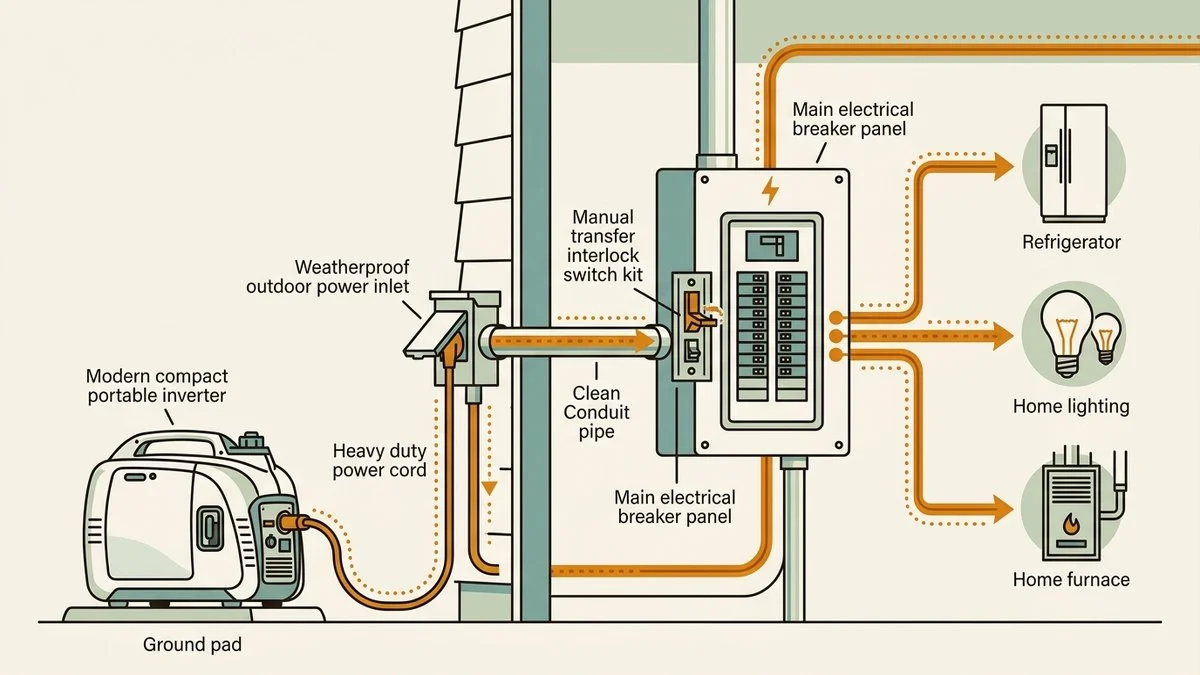
Can an inverter generator power a house?
Unlike noisy open-frame contractor generators whose voltage dips and harmonic distortion can exceed 15–20% THD, an inverter generator rectifies alternator power to DC and reconstructs a smooth 60 Hz (or 50 Hz) pure sine wave at under 3% THD. That clean waveform protects sensitive modern electronics—including variable-speed ECM gas furnace boards, inverter refrigerators, computers, and UPS units—while cutting fuel burn via eco-throttle speed control.
The real limit is not waveform quality; it is output voltage and inlet ampacity. Small 2,000 W suitcase inverter generators only output 120 V single-phase, meaning they cannot energize 240 V two-pole breakers (such as central air conditioners, electric dryers, or deep submersible well pumps) without load management on individual 120 V circuits.
30-amp vs 50-amp generator inlet limits (US 120V/240V)
In North American split-phase panels, total power limit follows Watts = 240 V × Amps. Matching your generator size to the wall inlet cord prevents tripped input breakers and overheated conductors:
| Hookup setup | Max continuous limit | Recommended inverter generator | What it powers comfortably |
|---|---|---|---|
| 120V extension cords or 15A/20A single-circuit inlet | 1,800 W – 2,400 W (120 V only) | 2,000 W – 3,500 W compact inverter | Refrigerator, WiFi, LED lights, laptops, TV, single space heater (staged) |
| 30-amp 240V inlet (NEMA L14-30) | 7,200 W (30 A × 240 V) | 5,000 W – 7,500 W dual-fuel inverter | Fridge, freezer, 120V gas furnace, 1/2 HP sump pump, lights, microwave, OR 3-ton central AC with soft starter |
| 50-amp 240V inlet (NEMA 14-50 / CS6365) | 12,000 W (50 A × 240 V) | 9,000 W – 12,000 W+ open/closed inverter | Everything above PLUS 240V well pump, soft-started central AC, or brief kitchen/water-heater cycling |
Manual transfer switch vs panel interlock kit
Never plug a generator into a wall receptacle with a double-male "suicide cord." Backfeeding an energized breaker panel without physical isolation endangers utility line technicians outside and destroys the generator the instant grid power returns. Under NEC Article 702, you have two legal manual options:
- Dedicated manual transfer switch (6 to 10 circuits): Sits beside your main panel and lets you flip pre-selected circuits (fridge, boiler/furnace, sump, kitchen outlets) one by one from Utility to Generator. Great when sharing a smaller 3,500 W–5,000 W unit because heavy unused breakers stay safely isolated.
- Main-panel mechanical interlock kit: A sliding metal plate attached to your main breaker cover so the 30A or 50A generator backfeed breaker cannot turn ON unless the main utility breaker is physically OFF. It gives you freedom to power any circuit in the house by toggling individual breakers manually, provided your total load stays within the generator rating.
Bonded vs floating neutral: why GFCI breakers trip
One of the most overlooked technical details when hooking up a portable inverter generator is neutral-to-ground bonding. A residential main electrical panel already connects the neutral bus to ground at the main service entrance.
If your portable generator also has an internal bonded neutral (meaning its neutral and ground wires are tied together inside the generator frame) and you connect it to a standard transfer switch or interlock without switching the neutral, you create an improper second ground-fault path. Modern GFCI and AFCI panel breakers detect that stray return current and trip immediately. Check your generator specification sheet: portable standalone use requires a bonded neutral, whereas feeding a house panel with an unswitched neutral requires configuring or choosing a floating-neutral generator—confirm the exact setup with a licensed electrician.
Deciding whether fuel backup, an all-in-one box, or silent wired lithium fits best? Compare portable power stations vs wired inverters, read our Inverter vs UPS vs Generator guide, check 30A vs 50A RV inverter sizing, or estimate runtime in the Battery Backup Time Calculator.
Frequently asked questions
Can an inverter generator power a house?
Yes, when connected properly through a listed transfer switch or main-panel interlock kit. A 5,000W to 7,500W dual-voltage (120V/240V) inverter generator connected to a 30-amp inlet runs a refrigerator, gas furnace, sump pump, lights, and internet, while a 9,000W to 12,000W unit on a 50-amp inlet can also support a 240V well pump or soft-started central AC.
What is the maximum wattage of a 30-amp vs 50-amp generator inlet?
At 240 volts (split-phase North American power), a 30-amp transfer inlet safely delivers up to 7,200 continuous watts (240V × 30A), and a 50-amp inlet handles up to 12,000 continuous watts (240V × 50A). Always keep your running load under 80% for sustained hours.
Is a generator interlock kit legal instead of a transfer switch?
In most US jurisdictions adopting NEC Article 702, a UL-listed mechanical interlock kit bolted onto your main breaker panel is a code-compliant alternative to a separate manual transfer switch, provided your local authority having jurisdiction (AHJ) permits it and your main panel has a compatible back-fed breaker position.
Why does a bonded vs floating neutral matter on an inverter generator?
When feeding a house panel that already bonds neutral to ground at the main service disconnect, a generator with an internal bonded neutral creates a second parallel ground path that can trip GFCI breakers. Portable standalone cord use wants a bonded neutral; house-panel hookups typically require a floating-neutral setup—verify your generator manual and electrician wiring.
