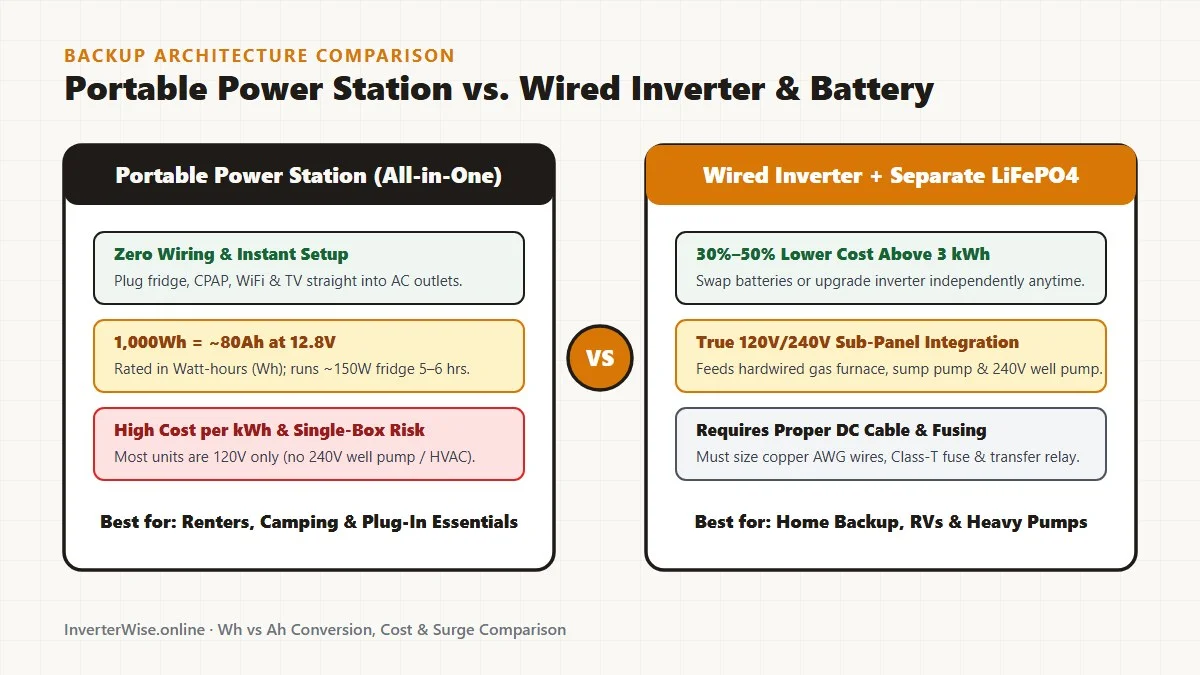
Wh vs Ah decoded (how much energy is inside the box?)
Manufacturers market portable power stations in Watt-hours (Wh), whereas standalone batteries sell in Amp-hours (Ah). Comparing them apples-to-apples takes one division:
Watt-hours (Wh) = Battery Volts × Amp-hours (Ah)• A 1,000 Wh portable power station holds the same raw energy as one 12.8 V 78 Ah LiFePO4 battery.
• One 12.8 V 100 Ah lithium battery equals 1,280 Wh (1.28 kWh).
• One 48 V (51.2 V) 100 Ah home backup battery equals 5,120 Wh (5.12 kWh).
On AC wall outlets, expect ~85% usable capacity after BMS overhead and inverter idle losses (1,000 Wh box ≈ ~850 Wh real AC power).
Portable power station vs component inverter side by side
| Factor | Portable Power Station | Wired Inverter + Separate Battery |
|---|---|---|
| Setup effort | Zero wiring; unpack and plug in | Requires thick DC cables, fuse, breaker & transfer relay |
| Repair & lifespan | All electronics glued/packed inside one warranty unit | Swap inverter, MPPT, or battery separately decades later |
| Real cost above 3 kWh | High (~2× more per kWh with proprietary add-ons) | Low–Medium (modular open-market 48V LiFePO4 packs) |
| Hardwired 240V circuits | Rare (120V only on most portable units) | Standard on 6kW+ split-phase inverters (well pump / central AC) |
| Portability | Grab handles or wheels; moves car-to-house easily | Wall-mounted permanently beside breaker panel or RV bay |
Motor surge, solar speed & the 240V home limit
Two practical limits trip up power-station buyers expecting whole-home performance:
- Idle inverter overhead: A 2,000 W AC inverter left switched ON consumes ~20–45 W continuously even when your laptop is asleep. On a 1,000 Wh power station, leaving AC outlets enabled overnight burns ~25–35% of the battery before your fridge even cycles!
- Hardwired 240 V pumps & gas furnaces: Compact 120 V power stations cannot energize 240 V well pumps, and floating-neutral AC sockets inside portable units sometimes fail gas furnace flame rectification checks unless connected carefully to a bonded transfer inlet—check our sump pump, well pump & furnace guide and house transfer switch wiring notes.
How to choose cleanly without overspending
Match the architecture to your living situation and outage profile:
- Renters, apartments & tailgating (under 1.5 kWh/day): A 1,000 Wh–1,500 Wh LiFePO4 portable power station gives silent, indoor-safe backup for CPAP machines, laptops, WiFi, and a mini/standard fridge with zero electrician fees.
- Homeowners & RVs needing hardwired backup (3 kWh–15 kWh): A wired pure sine inverter + modular LiFePO4 bank delivers far more battery per dollar, supports full rooftop solar MPPT charging, and ties seamlessly into your breaker sub-panel.
Still sizing watts and motor surges? Run your appliance list in our Inverter Size Calculator first.
Frequently asked questions
How many Ah is a 1,000Wh portable power station?
At standard 12.8V LiFePO4 battery voltage, 1,000Wh equals roughly 78 Ah (1,000 ÷ 12.8 = 78.1 Ah). After accounting for DC-to-AC inverter conversion losses inside the power station (~85% end-to-end usable AC energy), expect around 850 Wh of real wall-plug energy delivered.
Which is cheaper per kWh: a portable power station or a wired inverter and LiFePO4 battery?
Above 2 to 3 kWh of storage, a wired pure sine inverter paired with standalone 24V or 48V LiFePO4 batteries typically costs 30% to 50% less per kWh than branded portable power stations—and lets you swap or expand batteries independently if one part ever fails.
Can a portable power station run a refrigerator or sump pump?
A modern refrigerator (150–250W running, ~800W surge) runs smoothly for 5 to 10 hours on a 1,000Wh to 2,000Wh pure sine portable power station. A 1/2 HP sump pump requires 2,000W+ of surge, meaning smaller 1,000W stations trip unless rated specifically for ≥2,200W peak AC surge.
When do you need a wired inverter instead of a portable power station?
Choose a wired system if you need hardwired backup to your breaker sub-panel for a gas furnace, 240V submersible well pump, central AC, or multi-day outages exceeding 5 kWh, where standalone 48V rack batteries and high-surge low-frequency inverters outperform all-in-one boxes.
