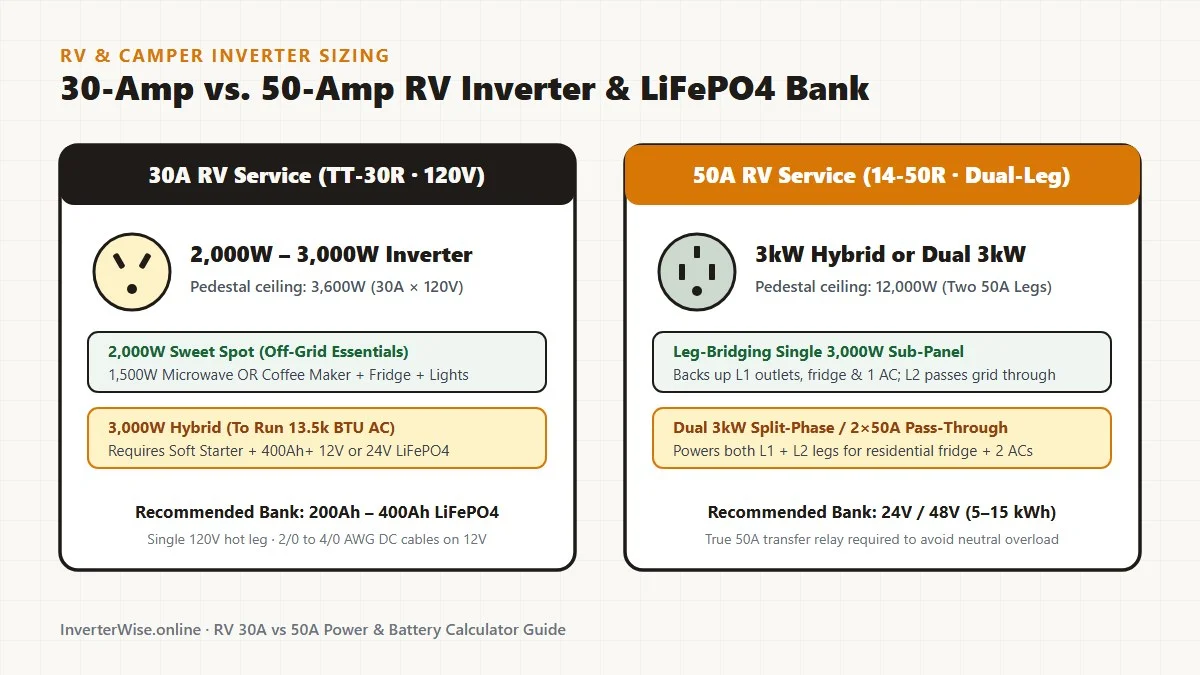
30-amp vs 50-amp RV shore power limits
Before picking an inverter size, look at the plug on your shore cord:
- 30-amp RV (NEMA TT-30): Single 120 V hot leg delivering up to 3,600 W continuous (30 A × 120 V). Most 30-amp hybrid inverter-chargers feature a built-in 30 A transfer relay, matching the coach panel naturally.
- 50-amp RV (NEMA 14-50): Two separate 120 V hot legs (L1 and L2, 50 A each = 12,000 W total) used for two rooftop air conditioners, electric water heaters, or washer/dryers. While campground 50 A feeds both legs at full shore power, off-grid inverters do not usually need to match 12,000 W unless running both ACs off a massive 48 V lithium bank.
Real RV appliance wattage chart (watch input vs label)
| RV appliance | Real AC input watts | Startup surge | Minimum inverter rating |
|---|---|---|---|
| 120V residential / 12V compressor fridge | 120 – 220 W | 600 – 900 W | 1,000 W pure sine |
| Drip coffee maker or Keurig | 800 – 1,500 W | Low | 2,000 W pure sine |
| RV microwave ("1,000 W" cooking) | 1,450 – 1,600 W | Brief spike ~1,750 W | 2,000 W pure sine |
| Hair dryer (high heat) or induction burner | 1,500 – 1,800 W | Low | 2,000 W – 3,000 W |
| 13,500 BTU rooftop RV AC (no soft start) | 1,300 – 1,550 W | 3,500 – 4,500 W LRA | 4,000 W+ (often trips smaller units) |
| 13,500 BTU RV AC (with soft starter) | 1,300 – 1,550 W | ~1,800 – 2,200 W | 3,000 W hybrid (on 400Ah+ lithium) |
2,000W vs 3,000W inverter for RVs & camper vans
Two sizes dominate North American camper builds for good reason:
- Pick 2,000 W when you avoid boondocking AC: Runs any single 1,500 W heating appliance cleanly (microwave, espresso machine, toaster, hair dryer) alongside fridge and lights, draws roughly ~185 A max at 12 V DC, and pairs comfortably with a 200 Ah to 300 Ah LiFePO4 bank.
- Pick 3,000 W when you want AC or zero load juggling: Lets you brew coffee while the microwave or residential fridge runs without tripping overload—and lets you cool down your bedroom for 1–3 hours using a soft-started 13.5k BTU rooftop air conditioner.
How inverters wire into a 50-amp dual-leg RV
If your fifth wheel or Class A motorhome has a 50-amp panel, avoid wiring a small 2,000 W inverter randomly across both legs without a proper dual-input transfer design. Standard safe architectures are:
- Inverter sub-panel (most practical): Move critical circuits (outlets, microwave, residential fridge, TV) to a 30 A sub-panel fed by one 3,000 W inverter-charger, leaving the water heater, electric fireplace, and secondary AC on shore/generator power only.
- Dual stacked inverters (50 A split-phase): Install two synchronized 3,000 W hybrid inverter-chargers—one on L1 and one on L2—for seamless whole-coach backup on large lithium banks.
LiFePO4 bank size & DC cable warning
A 3,000 W inverter pulling full rated output from a 12 V battery draws roughly 285 A DC continuously (3,000 W ÷ 12 V ÷ 0.88)—enough to overheat undersized wires in minutes and trip a standard single 100 A BMS battery. Always check both 12V vs 24V/48V tradeoffs and exact copper conductor thickness in our DC Cable Size Calculator (at 12 V, a 3,000 W inverter typically demands dual batteries in parallel plus 4/0 AWG short leads and a Class-T fuse).
Want to see how many overnight hours your coach battery lasts on fridge + fan + laptops? Plug your amp-hours into the Battery Backup Time Calculator.
Frequently asked questions
Is a 2,000W or 3,000W inverter better for a 30-amp RV?
For off-grid essentials (refrigerator, residential TV, laptops, CPAP, microwave OR coffee maker used one at a time), a 2,000W pure sine inverter is the sweet spot. Step up to a 3,000W hybrid inverter-charger if you want to run a soft-started 13,500 BTU rooftop AC off lithium batteries or operate two medium kitchen appliances together.
Can a 3,000W inverter run an RV air conditioner without a generator?
Yes, typically for short periods, if two conditions are met: your rooftop 13,500 or 15,000 BTU AC has an electronic soft starter (dropping LRA surge below 20–25A), and you have at least 400Ah of 12V LiFePO4 (or equivalent 24V/48V lithium). Expect roughly 1,300W to 1,600W continuous draw while cooling.
Can a 1,000W RV microwave run on a 1,500W inverter?
Often no—or right on its thermal trip edge. A microwave labeled "1,000W cooking power" typically pulls 1,450W to 1,600W of actual AC wall input power due to magnetron inefficiency. Pair microwaves and drip coffee makers with at least a 2,000W continuous pure sine wave inverter.
How do you wire a single inverter into a 50-amp dual-leg RV breaker panel?
A 50-amp RV pedestal delivers two 120V hot legs (L1 and L2, 50A each). A single 120V 3,000W inverter can power all non-AC outlets via a sub-panel or automatic leg-bridging relay on battery, while passing full 50A shore power through. Never overload a shared neutral wire—follow the inverter manufacturer schematic and use an RV electrician.
