Why US electricity tariffs changed the solar math
For years, sizing home solar anywhere in North America was simple: look up your annual kilowatt-hours on the bill, match the panels to produce that many kWh over a year, and rely on 1:1 net metering to trade daytime exports for nighttime power.
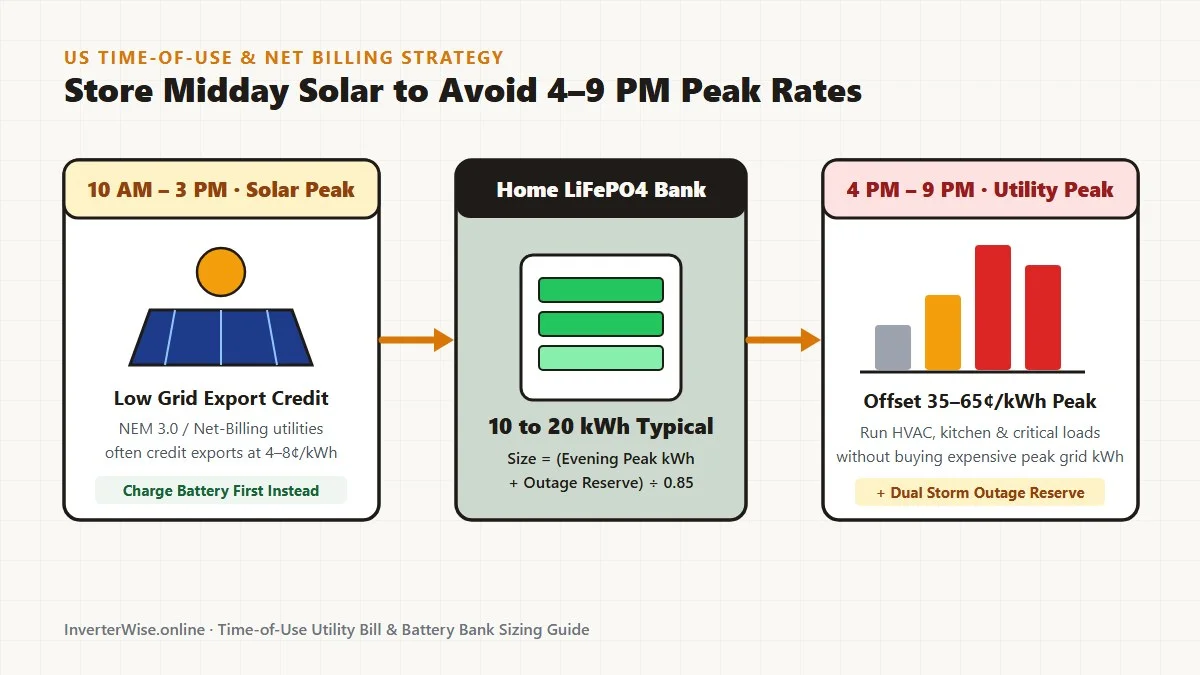
Today, utilities across California (PG&E, SCE, SDG&E under NEM 3.0), the Northeast (ConEd / National Grid Time-of-Use), and deregulated Texas retail plans price power by when you use or export it. Exporting extra solar at 1 PM when the grid already has abundant sunlight earns avoided wholesale value, while buying electricity home at 6 PM costs peak retail rates. In addition, because the direct federal residential Section 25D credit expired after 2025, matching battery size strictly to your real peak load—instead of overbuying excess capacity—matters more than ever.
Three US utility rate structures compared
| Billing model | Daytime export value | Evening import price | Right battery strategy |
|---|---|---|---|
| Classic 1:1 Net Metering | Equal to retail kWh rate | Same or tiered retail rate | Small battery sized strictly for blackouts (or none if outages are rare) |
| Time-of-Use (TOU) + Net Billing (e.g., NEM 3.0) | Low avoided-cost credit (often 4–8¢/kWh midday) | High On-Peak (often 35–65¢/kWh, 4–9 PM) | Charge from midday solar → discharge full On-Peak window daily |
| Deregulated / Solar Buyback (e.g., ERCOT Texas) | Varies by Retail Electric Provider plan (wholesale or capped) | Fixed or VPP demand-credit window | Self-consume peak evening AC loads + reserve for Texas grid outages |
Step-by-step battery kWh sizing from your utility portal
Before shopping by brand, log into your utility account and download one summer and one winter day of hourly interval usage (Green Button CSV). Follow three steps:
- Sum your On-Peak hours: Add every kWh consumed between peak start (usually 3 PM or 4 PM) and off-peak return (8 PM or 9 PM). If your HVAC, cooking range, and dryer run at 6 PM, that 5-hour window often averages 8 kWh to 15 kWh.
- Divide by usable efficiency: LiFePO4 batteries typically deliver ~90% depth of discharge and ~90% round-trip inverter conversion (
0.90 × 0.90 ≈ 0.81, or divide evening kWh by ~0.85 for practical planning). So a 10 kWh evening load needs roughly 11.8 kWh of nameplate battery. - Verify peak inverter kW output: Having 15 kWh in the bank means nothing if your hybrid inverter is only 3 kW while your central AC, oven, and dryer pull 7 kW simultaneously. Check peak load in our Solar Inverter Size Calculator and Appliance Wattage Calculator.
Balancing daily bill savings with storm outage reserve
Every modern hybrid inverter lets you set a Reserve State of Charge (SOC)—for example, keeping the bottom 25% or 30% untouched during normal utility days in case a hurricane, ice storm, or wildfire Public Safety Power Shutoff (PSPS) hits unexpectedly.
Compare your hourly backup capacity in the Battery Backup Time Calculator, and read our general electricity bill reading guide and lithium battery lifecycle comparison before finalizing your bank.
Frequently asked questions
Why do solar panels alone save less under Time-of-Use (TOU) and NEM 3.0?
Traditional 1:1 net metering gave full retail credit for midday solar exports. Under net billing and Time-of-Use tariffs (such as California NEM 3.0), midday utility export credits drop sharply while evening peak electricity (typically 4 PM to 9 PM) climbs to 35 to 65 cents per kWh. Storing daytime solar in a battery avoids buying those expensive evening kilowatt-hours.
How many kWh of home battery do I need to cover 4 PM to 9 PM peak hours?
Check your utility smart-meter portal for hourly usage between 4 PM and 9 PM on heavy AC or cooking days. Most average US homes use 8 kWh to 15 kWh during that 5-hour evening window. After accounting for ~85–90% inverter efficiency and keeping a 20% backup reserve, a 10 kWh to 20 kWh LiFePO4 battery bank fits most peak-shaving goals.
Should I size my solar battery differently for hurricanes or winter blackouts?
Yes. Peak-shaving only needs enough kWh to bridge 4 PM to 9 PM every day. Outage resilience requires covering critical loads (fridge, sump pump, furnace blower, internet, lights) for 12 to 24+ hours without relying on guaranteed next-day sun—often requiring a dedicated backup reserve threshold in your inverter settings.
Can you still use the same calculator math if your utility offers flat 1:1 net metering or ERCOT solar buyback?
Yes, the kWh energy math is identical. Where utilities offer full 1:1 net metering credits, the grid acts as a free battery and you size batteries strictly for outage backup hours. Where export rates fall below retail import rates (or demand peak-hour arbitrage), add evening peak kWh to your daily storage target.
